
 Ver todas las publicaciones


Driving Toward a Degree 2025: Delivering Value and Ensuring Viability, the most recent edition of a regular research series report from Tyton Partners, illuminates an inflection point for higher education. Institutions are contending with shrinking budgets, new federal accountability rules, and continued public skepticism about the return on investment of a degree, all while trying to serve increasingly complex student needs. The research frames student support not as an auxiliary service but as a strategic imperative for institutional survival.
Drawing on national survey data from students, administrators, faculty, and student support professionals, Driving Toward a Degree 2025 examines how colleges and universities are re-evaluating student success strategies. Survey questions examine themes such as financial viability, career readiness, advising challenges, and technology-enabled solutions, and the study finds that institutions recognize the urgency of acting but remain constrained by resources and structure. For example, high caseloads, fragmented systems, and limited coordination keep many campuses from meeting students’ expectations for holistic, career-aligned academic advising.
Cathy Shaw, managing director at Tyton Partners and one of the co-authors of the report, says, “Every day you could open Inside Higher Ed or The Chronicle of Higher Education and see more institutions merging or some closing, so we thought viability is a real concern, particularly in the face of the demographic cliff and bans on international students. This year, more than others, there was more emphasis on what sustains institutions so they can carry on their missions.”
Shaw says improving student supports is essential not only for retention but also for rebuilding trust in college education, and that Driving Toward a Degree 2025 makes the case that student supports can be central to improving viability, particularly by linking the value of college to career readiness, defining holistic support broadly, and effectively blending high tech and the human touch in advising.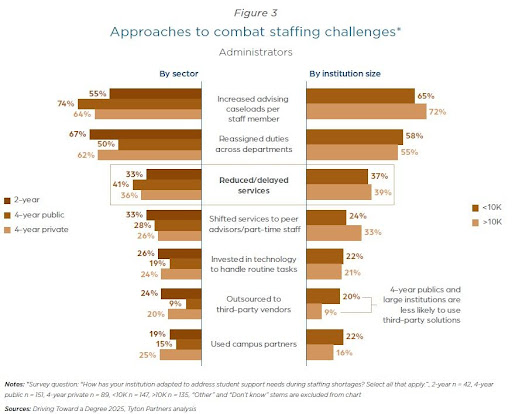
Financial pressures are putting student supports at the center
The report shows that nearly 30 percent of institutions anticipate substantial budget decreases for student services over the next three years, and another 50 percent expect flat funding, even as student needs continue to grow. Among four-year public institutions, 38 percent expect budget cuts. Yet administrators still rank student supports as a top-two institutional priority, second only to enrollment efforts.
Under staffing pressure, colleges still avoid tech-first solutions
But comparing those responses to another part of the report, Shaw says, brings up a notable tension. When administrators are asked how they plan to deal with staffing challenges, the top responses are about how to align people and their caseloads, while none are about using technology effectively.
“Nobody I spoke to about this feels increasing caseloads or delaying services are great solutions, because caseloads are already too high and people are already under a lot of pressure to deliver what’s in their remit, never mind pick up some additional responsibilities,” Shaw says. “But looking for technology as a solution to combat staffing challenges in student support isn’t a top-three response.”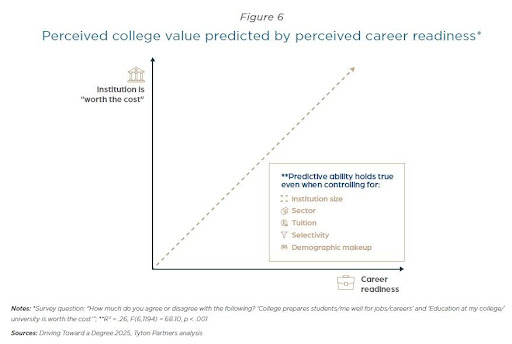
AI is welcome for transactional tasks
However, the report also finds that many campus leaders see potential for technology, particularly AI, to relieve some of those pressures when used carefully for routine tasks. The top barrier to generative AI use for administrators and frontline support staff is a lack of trust rather than a lack of interest.
That may explain which uses for AI university personnel are looking for. “They are okay with AI being used in more transactional elements of student support,” Shaw says. “Course registration has the most votes, and almost no one agrees mental health counseling should be provided by automated services. That’s logical, I suppose. What’s interesting is academic advisors think helping students explore research and career opportunities is a good place for AI to be deployed.”
Career readiness is strongly tied to belief that college is worth the cost
Shaw says Driving Toward a Degree 2025 is interesting to read alongside other surveys of the general public that show doubts about pursuing higher education. “Here, we’re interrogating institutional stakeholders’ perceptions of the college degree,” she explains. “Do I believe my career matters? Do I believe I’m delivering services, support, teaching, or administrative decision making that should command the tuition, fees, and everything else? Do I believe I’m delivering something of value?”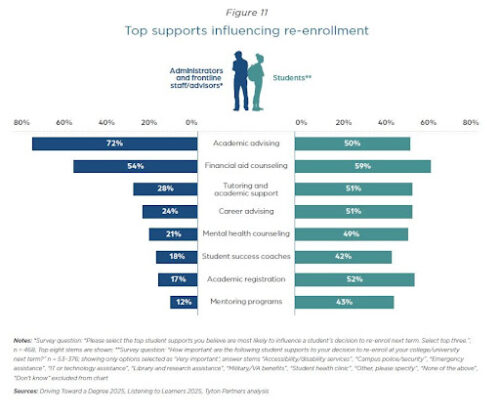
Among the notable results of the survey is that for both students and employees, perception of the value of their institution is strongly correlated to the perception that it prepares students for jobs and careers. For example, among students who believe college prepares them well for jobs and careers, 95 percent say college is worth the cost, but less than half of students say so when they do not believe they are being prepared well for jobs and careers.
Students define holistic support more broadly than institutions do
When advisors, administrators, and other frontline professionals are asked what advising supports influence re-enrollment, responses are heavily weighted toward two categories — academic advising and financial aid counseling.
However, student responses are spread more evenly across many more supports. “Curiously, the specific question has nothing to do with whether or not they use those services,” Shaw says.
“They just want to know that they’re there. This question shows how students really believe institutions should define holistic student support.”
Read more insights from Driving Toward a Degree 2025