 Ver todas las publicaciones

Faculty seeking to help students see how a course connects to their professional future don’t necessarily need to create new assignments. Often students benefit just from faculty using existing assignments to communicate a clearer signal about why that work is relevant to their career concerns. That might be a syllabus statement that names the communication skills developed in English 101, a reflection activity that asks students to explain how their lab project promoted critical thinking, or translating their work on a traditional research paper for a professional audience.
Those are the kinds of examples featured in The Career Readiness Imperative in Gateway Courses, a new trend report and playbook from Every Learner Everywhere on how colleges and universities are helping students experience the relevance of academic learning earlier, more explicitly, and more consistently. One major finding of the report is that faculty in academic courses do not need to become experts in industry or the professional roles students may go into. They can have a big impact simply by finding small moments that let students practice connecting their academic work to their imagined professional futures.
Another finding is that, with support from colleagues in career services and centers for teaching and learning, those small moments can grow into a comprehensive institutional-level plan. At many colleges and universities, career readiness is moving from tweaks in language on an individual instructor’s assignments to a consistent student experience, supported by shared frameworks, pre-built lessons and modules in the LMS, digital tools, and other structures that make it easier for more instructors to participate.
Below are 25 examples of faculty making their courses more relevant by blending in career readiness. They are weighted heavily toward general education and other gateway courses in academic subjects — the specific concern of The Career Readiness Imperative in Gateway Courses — but a few examples from advanced courses in the majors, including in professional programs, are included for illustration and inspiration. Many of the career readiness examples below build on the eight workplace competencies from the National Association of Colleges and Employers (NACE), a framework to help students understand how the objectives of academic programs overlap with the durable and transferable skills employers seek.
Examples of making academic learning relevant to career readiness
Career portfolio assignment in health professions
At University of Connecticut, Allied Health 1000, a one-credit introductory course, includes a career portfolio assignment that asks students to assess the NACE competencies they expect to develop for their intended career, along with their current strengths and how the course materials have been relevant. A faculty development resource page includes examples from past students.
Optimizing a gateway course for health profession majors
Lorain County Community College revised its high-DFW anatomy and physiology gateway course to emphasize hands-on labs and formative assessment. Pass rates rose from about 35 percent to 66 percent, strengthening downstream nursing licensure performance and workplace-aligned competencies.
Career-connected assignments across disciplines
The five institutions in the Alamo Colleges District in Texas built an experiential learning transcript capturing the outcomes of field-relevant assignments and projects across the curriculum. Students document how their course activities translate into readiness for internships and employment. (ibid)
Oral presentation skill development with AI feedback
Peggy O’Neill in the Writing Department at Loyola University Maryland created an assignment on a job interview simulation platform in which students answer questions about their course presentation topics and receive automated feedback.
Applying course skills to analyze job postings data
In a data analytics course at Loyola University Maryland, Dr. Dobin Yim asked students to analyze job postings, create evaluation criteria aligned with their own career goals, identify required skills, and write a reflective report. (ibid)
Syllabus language from the first semester
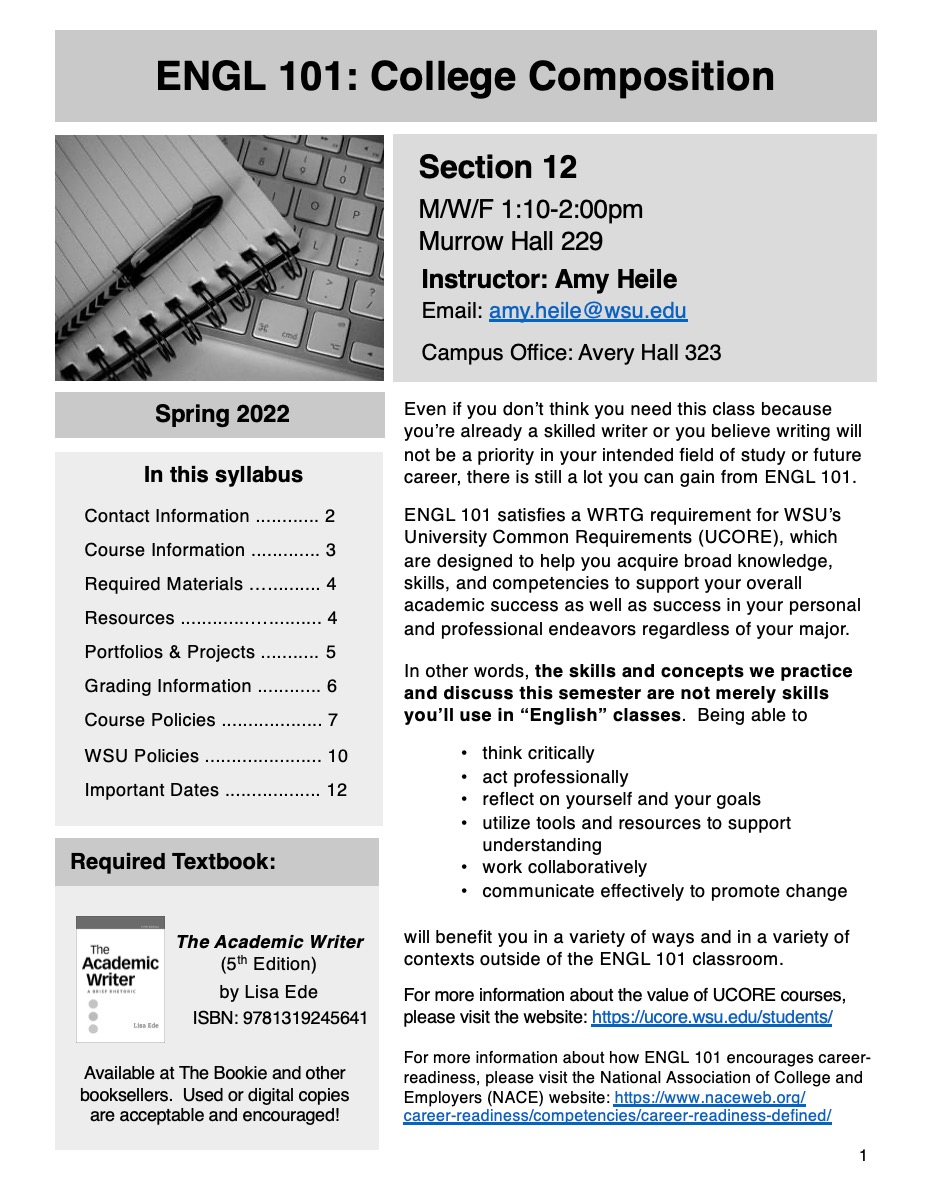
In English 101 at Washington State University, faculty revised syllabus statements to explicitly identify which NACE skills are developed through major assignments. These explicit statements help students understand the relevance of academic writing to professional communication expectations.
Interventions in one university’s core curriculum
A resource page for Washington State University’s Core to Career faculty fellowship program outlines how multiple faculty incorporated career readiness into the institution’s general education program.
Cover-letter-as-reflection in an academic writing course
In English 201: Research and Writing, Rachel Sanchez integrated the NACE competency of career and self-development through an assignment requiring students to write a professional cover letter to a scholarship committee or graduate program. The letter showcases their development as writers and makes skill growth explicit.
Podcast production as team-based inquiry
Anna Whitehall designed a final project in her 200-level Department of Human Development course so students create an interview-style podcast in lieu of a traditional paper. The topic of the podcast assignment connected back to the university’s common reading book for the year. Teams conducted interviews, scripted episodes, and produced the audio using professional tools.
Professionalism self-assessment in a history gateway course
In History 105: Roots of Contemporary Issues, Eugene Smelyansky embedded the NACE competency of professionalism by having students conduct structured self-assessments on attendance, participation, note taking, and active listening. Students proposed their own professionalism grade at semester’s end and described growth areas.
Reflection to improve group work practices
To help students get more out of group work activities and to understand the communication skills gained during an Introduction to Mythology course, Tomie Gowdy-Burke had students learn about and assess themselves on the NACE communication competency.
Homing in on critical thinking
In his 300-level biomedical ethics course, philosophy professor Bill Kabasenche adds a reflection question to every traditional written assignment asking students to explain in increasingly more complex ways how they are applying critical thinking.
Real-world scenarios to heighten relevance
In his fundamentals of macroeconomics course, Alejandro Prera eventually has students propose specific policy ideas but prefaces that work with accessing publicly available information about a single country and analyzing socioeconomic data about its population.
A compendium of examples from career success faculty fellows
One of the most inspiring sources found during the literature scan for The Career Readiness Imperative in Gateway Courses was a report on four years of work in the Career Success Fellows program across the 25 campuses of the City University of New York. The report profiles more than 50 individual faculty who have taken innovative approaches to connecting academic courses to career readiness. Some of the highlights include:
- A psychology professor who references career skills in every activity during the semester and embeds one question about those skills on the final exam.
- An English course that invites students to write a proposal for including professionalization and career readiness into other courses.
- An Introduction to Human Services course where students submit a résumé and cover letter, attend career workshops, and complete three structured reflections on strengths, areas for improvement, and internship preparation.
- A gallery and museum studies course that teleconferences working professionals into the classroom to discuss career paths with students.
- An anthropology course where students connect results from an assessment by a career coach to their major and draft a résumé and LinkedIn profile reflecting newly acquired competencies.
- A public health professor who aligned assignment objectives so students learn course concepts and professional behaviors simultaneously, seeing how the field requires both disciplinary and interpersonal competencies.
- A dance course where students write personal mission statements articulating professional and artistic goals.
- A criminology course where HR professionals visit class to workshop students’ résumés, LinkedIn profiles, and cover letters.
- A health informatics course where the professor surveys working adult students about their current job roles and future aspirations, then adjusts assignments accordingly. Coursework emphasizes emerging skills working students can immediately apply in their current jobs.
- An accounting sequence where students practice using industry-relevant software and learn how emerging technologies shape expectations in contemporary accounting roles.
- An English department that hosts a welcome event linking majors to internships and career opportunities. The department also created a short video for its website promoting the relevance of courses to professional pathways.
- A chemistry course where the instructor organizes guest speakers and networking events in chemistry-related fields.
- A graduate landscape architecture program where faculty built an alumni group on LinkedIn to connect current students with mentors.
Career relevance where learning already happens
These examples show how higher education is moving beyond the idea that career readiness belongs only in advising offices, career centers, internships, or professional programs. Innovative faculty are partnering with those offices to develop practical ways to help students recognize the relevance of their academic coursework to their future careers. They are making that connection in existing structures such as writing assignments, lab reports, group projects, presentations, research papers, and the other academic work that shapes the early college experience.
Download The Career Readiness Imperative in Gateway Courses