
A Balanced, Student-Centered Approach to Artificial Intelligence (AI) in Higher Education
Artificial intelligence is rapidly reshaping teaching, learning, and institutional operations. Every Learner Everywhere advocates for a balanced approach—one that recognizes AI’s potential to enhance efficiency, creativity, and accessibility while maintaining academic integrity and accountability. Our work emphasizes AI literacy, responsible use, and thoughtful integration into both academic and administrative contexts.
Every Learner Everywhere supports the responsible, intentional use of AI to advance accessibility and student success across higher education
Explore AI-related tools, insights, and learning opportunities to support institutions as they navigate AI with care and purpose.
AI Resources
The Every Learner AI resources offer insights for a balanced approach to AI in higher education, recognizing its potential to enhance efficiency, creativity, and accessibility while maintaining academic integrity. Our resources emphasizes the importance of AI literacy and responsible use, encouraging institutions to integrate AI tools thoughtfully and with intentionality into curricula and administrative processes.

enero 2026
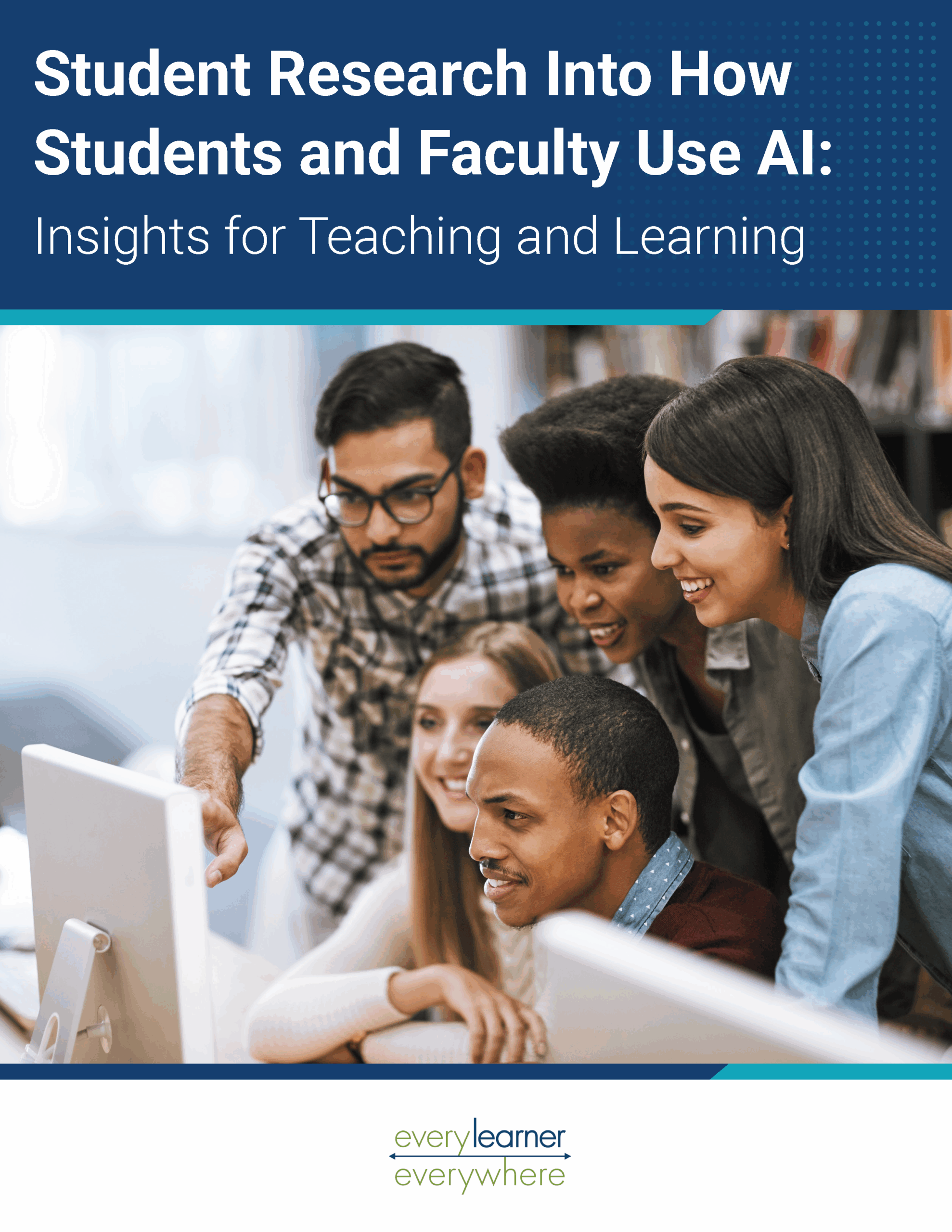
This report offers a student-centered examination of generative AI in higher education—not a guide or endorsement, but a record of genuine student inquiry into AI’s potential and limitations. Students are already using AI, regardless of institutional policies. This student research helps faculty understand not just what tools students are using, but how they’re thinking about AI’s role in their education.
octubre 2025
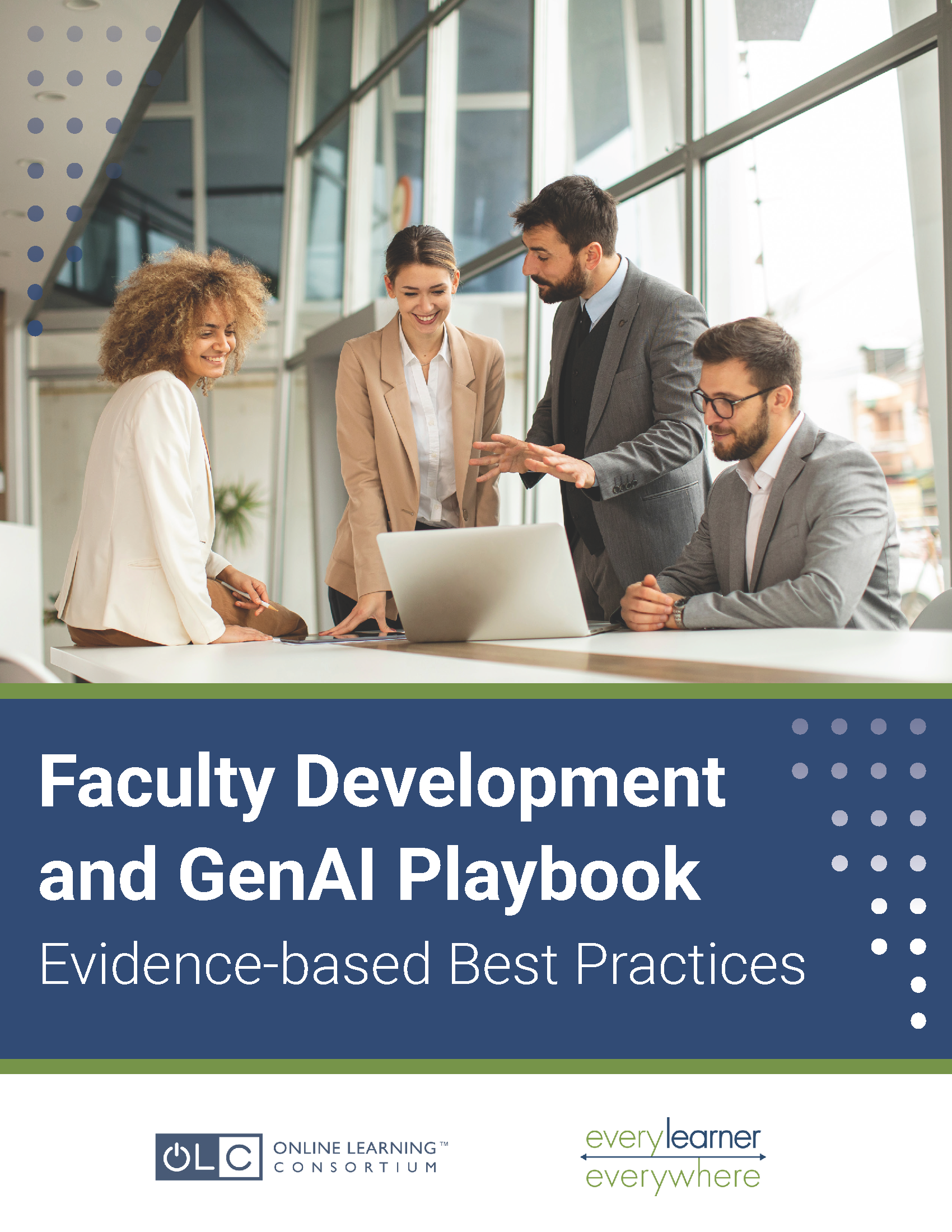
This playbook is designed to guide faculty development professionals in colleges, universities, and other higher education organizations to develop and implement GenAI professional development opportunities for faculty and staff.
marzo 2025
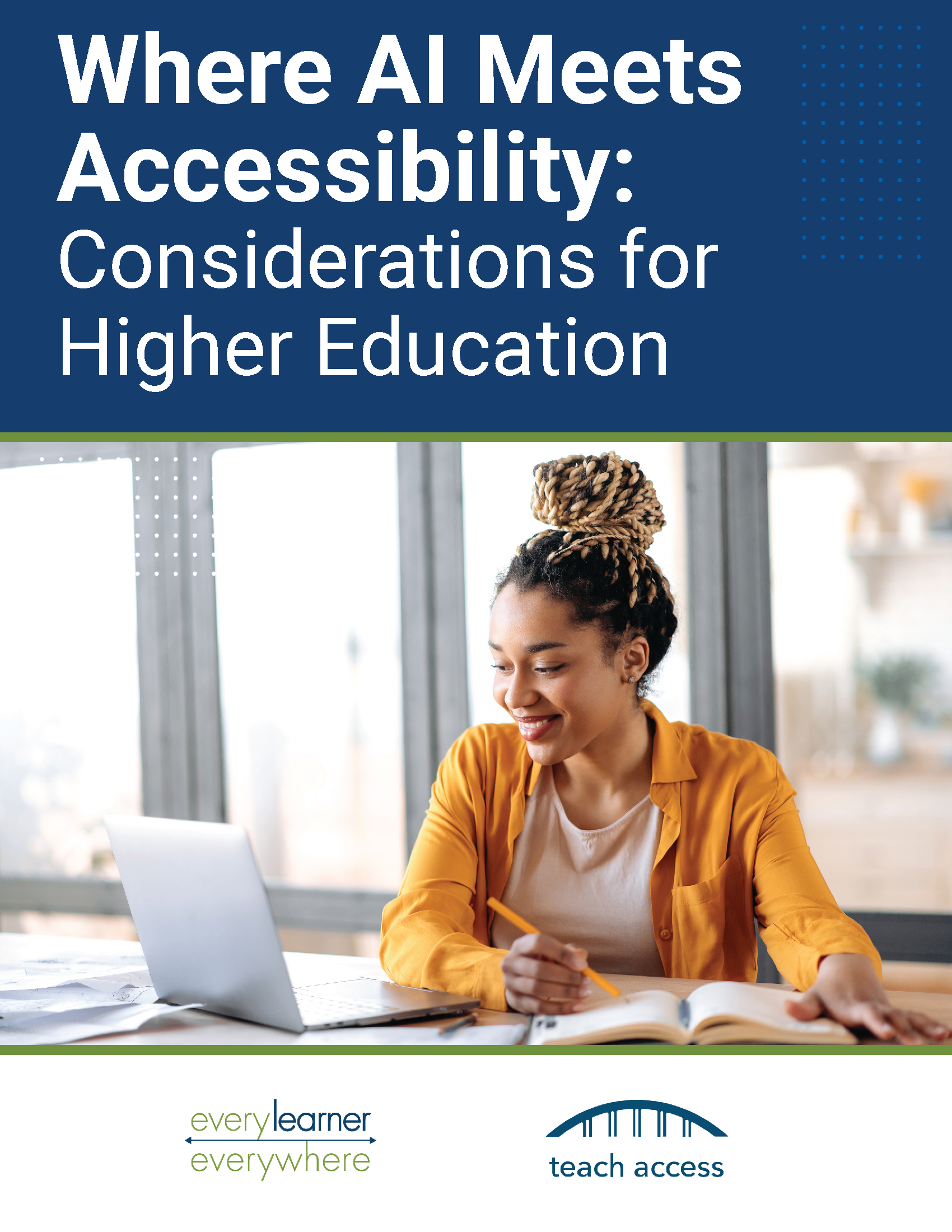
As AI becomes increasingly embedded into educational settings and practices, it offers both opportunities and challenges. This comprehensive resource will help navigate both aspects — demonstrating how AI can help overcome technology barriers, including various recommendations for integrating accessible AI across different areas of higher education.
AI Blogs and Insights
Our blog explores how AI intersects with accessibility and student success in higher education. These articles support campus leaders, faculty, and staff as they consider how AI can be used thoughtfully—without reinforcing existing barriers to student success.
Artificial intelligence has already been integrated into many assistive technologies (AT), improving their functionality and making daily tasks more accessible for people with disabilities. Tools like screen readers, speech-to-text software, …
In her recent AI literacy courses for international and multilingual learners at Temple University’s Center for American Language & Culture (TCALC), Meghan Killeen found that what students “really needed the …
How do faculty developers quickly and effectively prepare faculty to integrate GenAI into their curriculum in a way that enhances teaching and learning? A four-stage developmental model in a new …
With AI tools increasingly shaping everything from assignment design to student services, institutions face a pivotal moment: Adopt AI in ways that expand access or repeat historic patterns of exclusion …
Many college and university faculty are considering what kind of AI literacy students should develop, and how that literacy should show up in coursework, assignments, projects, and assessments. In response, …
Generative AI is already embedded in students’ academic routines, whether or not their courses explicitly address it. In interviews conducted by student interns during the 2024–25 academic year, undergraduates described …
Generative AI is reshaping how faculty design assignments, give feedback, and think about academic integrity, often faster than institutional guidance can keep up. For centers for teaching and learning, faculty …
As AI becomes more visible across higher ed, conversations around the technology are often centered on the risks, including plagiarism, misuse, and institutional implementation. Less attention is given to the …
As colleges and universities expand the use of AI to support digital accessibility, questions about human validation in AI accessibility work have moved to the foreground. Recent changes to Title …
One way for faculty to incorporate an emerging and fast-evolving technology like AI into their courses is for each of them, individually, to develop lessons and activities. Another is to …
Higher education is at an inflection point. AI adoption across campuses has moved from curiosity to widespread availability. Ellucian’s 2026 survey of higher education professionals found that 90% now use …
A new initiative to combine AI-enabled courseware and evidence-based teaching practices in Calculus I is building on lessons Every Learner Everywhere has accumulated from its earliest work. While Every Learner …
AI Workshops
Our recorded webinars and video resources feature higher education practitioners, researchers, and policy experts discussing real-world AI implementation, challenges, and opportunities.
As colleges and universities increasingly integrate artificial intelligence into teaching and learning, accessibility must remain at the forefront of course design. This webinar will explore how instructional designers, faculty, and course builders can harness AI to create inclusive, equitable, and accessible learning experiences for all students.
This webinar invites faculty, librarians, instructional designers, and learning support staff to hear directly from students about the real-world ways they’re leveraging generative AI and other emerging technologies to navigate learning challenges, adapt inaccessible content, and advocate for others by developing AI tools that increase accessibility.
This webinar, a collaboration between Teach Access, Every Learner Everywhere®, and Northwest Higher Education Accessibility Technology group (NWHeat), introduces the foundational concepts of digital accessibility for students in the context of AI tools, focusing on how these technologies can both support and challenge access for learners with disabilities.
This session delves into the real-world application of AI in corequisite Mathematics classrooms, highlighting its potential pitfalls, such as algorithmic biases, and the subsequent equity issues. Participants will learn from instructors that have embraced AI, gleaning insights from their real-world experiences and best practices for equitable implementation.
This session delves into the real-world application of AI in the corequisite English classroom, highlighting its potential pitfalls, such as algorithmic biases, and the subsequent equity issues. Participants will learn from instructors that have embraced AI, gleaning insights from their real-world experiences and best practices for equitable implementation.
This insightful webinar delves into the exciting realm of Artificial Intelligence (AI) and its impact on higher education, focusing specifically on the student experience. Whether you are an educator, administrator, or student curious about the future of education, this webinar provides valuable insights into the evolving landscape of higher education through the lens of AI and the student experience.
AI Toolkit Database
The AI Toolkit Database is a student-curated, living resource that catalogs more than 70 generative AI tools commonly used in higher education. Organized by use case, the database helps institutions better understand the rapidly evolving AI landscape from a student perspective.
Each entry includes details on functionality, pricing, data sources, and privacy considerations—supporting more informed, transparent decision-making around AI adoption.
Explore the AI Toolkit Database