Every Learner Everywhere
Teach Access
Part of
Pillar Resources
Pillar Resource

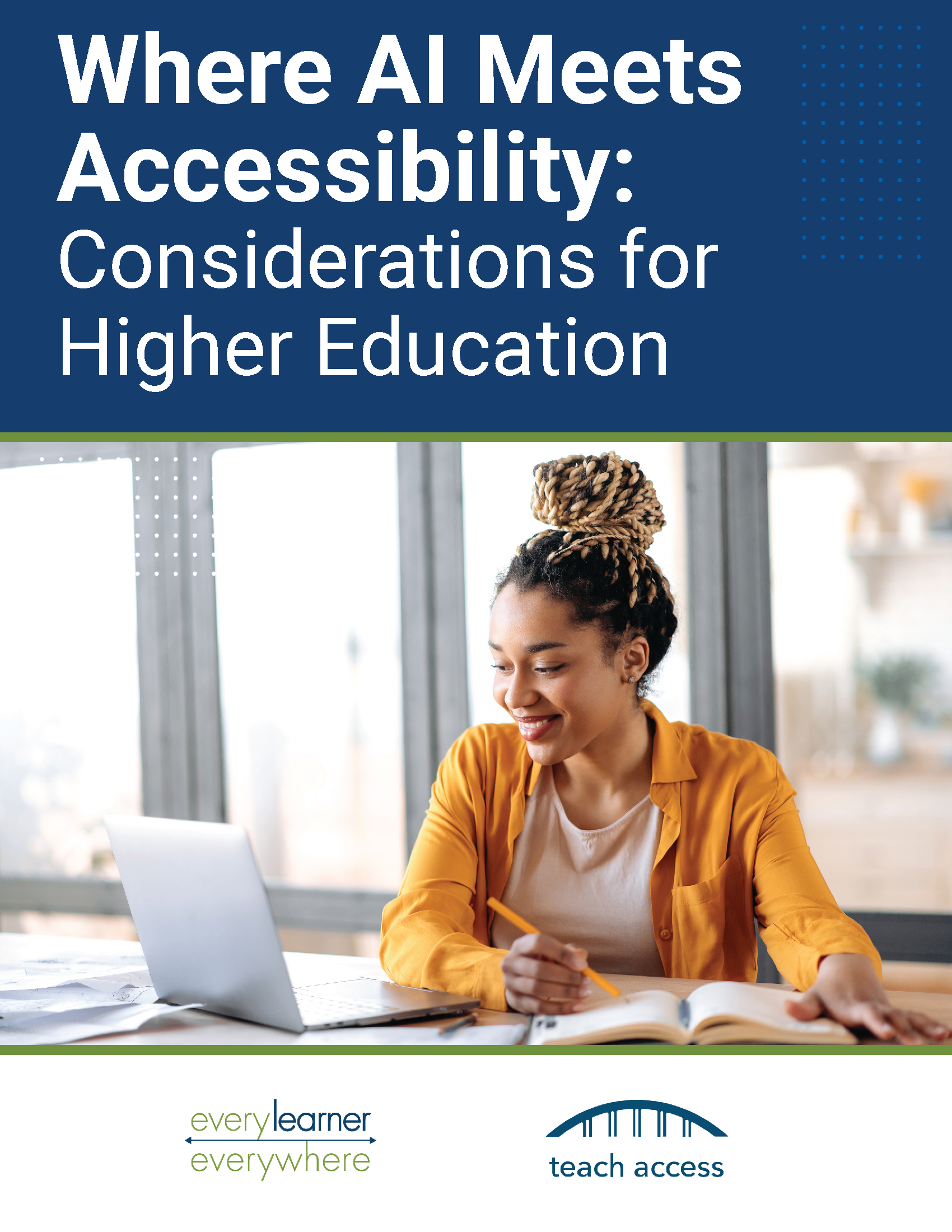
Where AI Meets Accessibility: Considerations for Higher Education

As AI becomes increasingly embedded into educational settings and practices, it offers both opportunities and challenges. This comprehensive resource will help navigate both aspects— demonstrating how AI can help overcome technology barriers and highlighting areas where it may inadvertently create new obstacles for people with disabilities (PWD).

Our goal is to shift the conversation around AI in higher education beyond topics like academic integrity or the student experience, and instead encourage a focus on how AI can promote accessibility and inclusion. The resource includes various recommendations for integrating accessible AI across different areas of higher education. It is also a practical toolkit complete with example activities, discussion questions, and reading lists.

Key highlights include:

  • Intro to Accessibility and AI, explaining key concepts and their relevance in higher education.
  • Specific challenges PWD face when using AI, including biases and ableist assumptions that may hinder accessibility.
  • The role of AI in assistive technology (AT), how it can be used as an assistive tool in educational contexts.
  • How AI can support accessibility, providing insights into making AI more inclusive.
  • Practical advice for educators and administrators on implementing and using AI inclusively.
Other Related Resources

Pillar Resource
Three college students walk on a campus path in front of a brick building, one in casual attire with a tablet, another in a suit with a backpack, and the third in military uniform carrying a folder. Image depicts the career readiness imperative.

abril 2026

This resource examines the growing trend of U.S. colleges and universities integrating career readiness into academic courses, with particular attention to gateway and general education courses early in degree programs. It focuses on how students experience the relevance of what they learn in these early courses, and it provides strategies institutions can use to help students experience that relevance earlier, more explicitly, and more consistently.

Resource Cover page from The IIRP Graduate School's Course Design for Student Success Rubric with title, photo of student holding tablet and org logos.

marzo 2026

The IIRP Graduate School’s Course Design for Student Success Rubric, is a robust rubric, designed to support student engagement, access, and success across varied learner populations and institutions, including undergraduate, graduate, 2-year, etc. We want to inspire faculty, instructional designers, and administrators along their path of continual improvement.

Pillar Resource
COVER page of Student Research Into How Students and Faculty Use AI- Insights for Teaching and Learning with title and photo and every learner everywhere logo.

enero 2026

This report offers a student-centered examination of generative AI in higher education—not a guide or endorsement, but a record of genuine student inquiry into AI’s potential and limitations. Students are already using AI, regardless of institutional policies. This student research helps faculty understand not just what tools students are using, but how they’re thinking about AI’s role in their education.