 Ver todas las publicaciones

Faculty commonly assign lab reports, presentations, discussion posts, research papers, and reflections that ask students to practice communication, problem solving, analysis, teamwork, and self-directed learning. All of those are skills valued by employers and that will help students launch professional careers. But academic courses can often still feel abstract and irrelevant to students’ career concerns when they aren’t able to name the skills they are learning and to practice talking about them in professional contexts.
Fortunately, a growing trend in higher education is to close that gap, which is explored in detail in a new report from Every Learner Everywhere. One finding of The Career Readiness Imperative in Gateway Courses: A Student Success Perspective, Trend Report, and Emerging Playbook is that simply making room to translate between academic objectives and professional competencies has a big impact.
The report describes how a growing number of colleges and universities are helping students experience the career relevance of early courses more explicitly while maintaining disciplinary integrity. Based on interviews with innovative programs and the national organizations supporting them, it outlines the major trends and identifies specific practices that individual faculty can adopt.
This article supplements that report with a curated list of classroom-ready tools faculty can adapt. It includes competency-mapping worksheets, student self-assessments, syllabus language, and templates for career exploration assignments. The examples below show how departments and innovative individual faculty, in collaboration with career services offices and centers for teaching and learning, are nurturing career readiness alongside traditional academic objectives in gateway courses.
Tools for mapping the career skills already present in the course
A practical first step is to identify where competencies valued in professional contexts already appear in a course. One theme of The Career Readiness Imperative in Gateway Courses is that employers and faculty in core academic subjects are already largely aligned, but implicitly rather than explicitly. The simplest way to start is by looking at existing learning outcomes, major projects, class activities, and assessments, then looking at the competencies outlined by the National Association of Colleges and Employers (NACE), and “crosswalking” them.
- The University of Connecticut’s Center for Career Readiness and Life Skills offers an Integrating Career Competencies resource page that supports faculty through four steps: awareness, alignment, articulation, and assessment. For the awareness stage, they offer a simple worksheet on aligning course objectives and NACE competencies.
- Roanoke College’s NACE Competencies and Student Outcomes guide includes similar worksheets, including a course-mapping activity departments can use to identify where students encounter, practice, and demonstrate those competencies across required courses.
- Washington State University’s Core to Career program offers a template for a Labor Market Insights Research Assignment which encourages students to learn more about a professional role that interests them and map its requirements back to the skills they are learning in the course.
Examples of adding career language to the syllabus
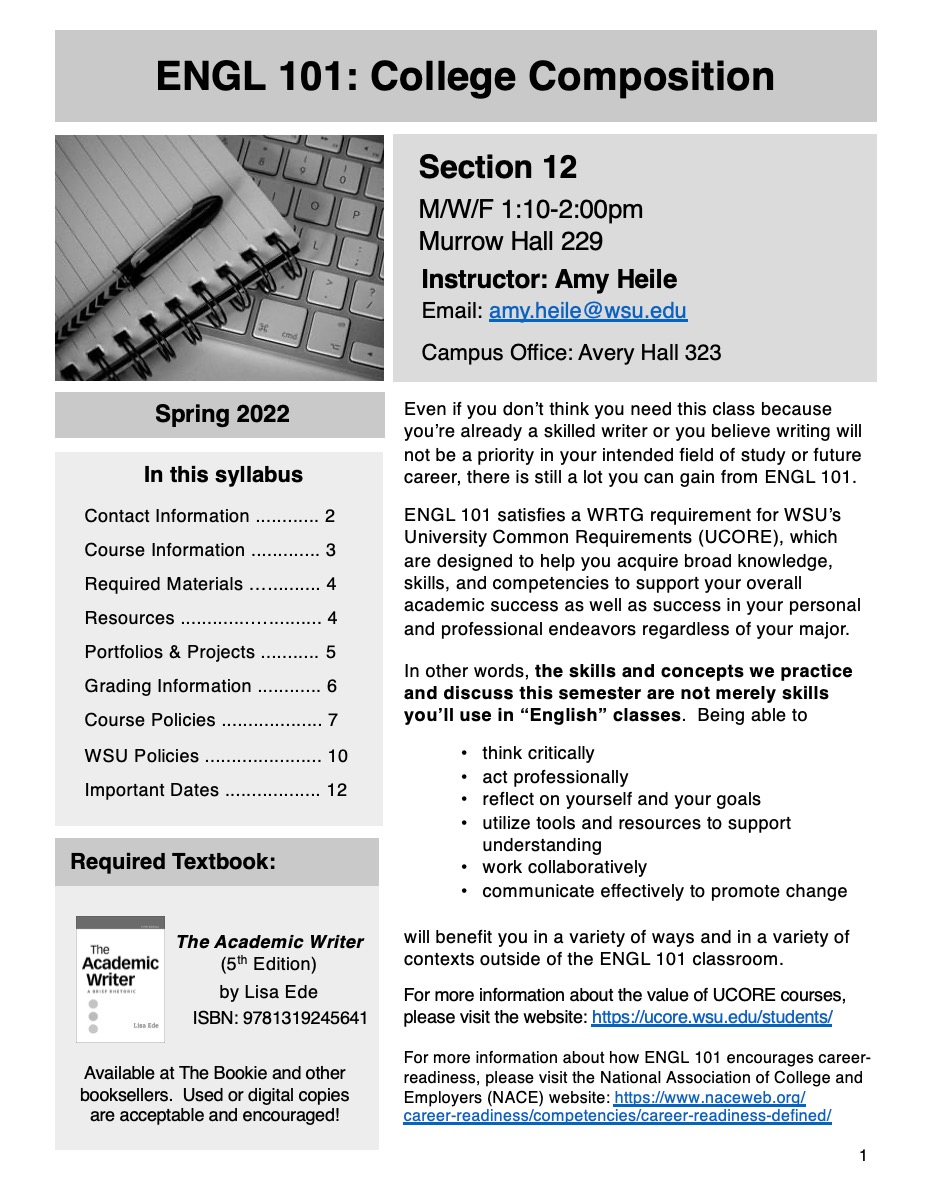
A syllabus can give students an early signal that the course helps them build skills with uses beyond the classroom. A resource page from Washington State University’s Core to Career program includes a sample English 101 syllabus statement that names course activities such as critical thinking, reflection, collaboration, and communication as career-related skills students will practice through the course.
Other sample syllabus language can be found on faculty resource pages from the career centers at University of California San Diego and University of South Florida.
The University of Connecticut Integrating Career Competencies resource page referenced above also includes links to sample syllabi for humanities and STEM courses. The latter example reads in part:
Identifying and articulating the NACE Career Competencies, technical, and transferable skills you acquire in this course and during your time at UConn are critical to Becoming Career Ready and your success both as a student and post-graduation. In this syllabus, opportunities have been noted where you can enhance and gain the Career Competencies and skills that employers and graduate programs are seeking. This will occur via assignments and class conversations and will contribute to your ability to identify and articulate these competencies and skills when applying for leadership roles, internships, jobs, graduate school, fellowships, and more.
These examples show how instructors can add an explanatory layer over the existing course design that helps students connect academic work to skills they will want to reference later in résumés, job applications, job interviews, or career-advising conversations.
Self-assessment activities that help students practice naming their career readiness
Self-assessment activities help students practice recognizing how their professional abilities are developing alongside their academic identities. These tools give students a vocabulary to translate what they learn through academic work into other contexts such as applications for internships or jobs.
- Rice University’s Center for Career Development offers a two-page Are You Ready for Your Career? self-assessment worksheet that asks students to rate their own development in each of the NACE competencies and suggests concrete ways to build those skills.
- A 10-page self-assessment activity from Marietta College includes a more comprehensive rubric under each competency.
- A self-assessment activity from the University of Tampa is in journal form, prompting students to reflect on and connect their experiences, strengths, challenges, and goals to the NACE competencies.
- A University of Northern Colorado career-planning resources page includes a transferable skills checklist in PDF and Microsoft Word formats. For example, it helps students break down a broadly defined competency like “dealing with data” into 14 specific activities they are likely to have encountered in their courses.
- The appendix of a Florida Atlantic University faculty guide on career readiness includes a template for a worksheet students can use to connect “soft skills” to their curricular, co-curricular, and employment experiences.
Implement career-readiness activities for college students
To see how these example self-assessments, worksheets, and syllabi language are put into practice, readers should explore Part III of The Career Readiness Imperative in Gateway Courses. The report offers a playbook illustrating how faculty in general education courses use tools like these in reflection activities, online modules, case studies grounded in real-world scenarios, interview simulations, and more.
Download The Career Readiness Imperative in Gateway Courses: A Student Success Perspective, Trend Report, and Emerging Playbook