
 Ver todas las publicaciones

In the summer of 2025, Dr. April Crenshaw stood in front of her MATH 1710 precalculus students at Chattanooga State Community College and shared the experience she had been having with new AI platforms. She had been experimenting with building a customized tool in ChatGPT to serve as a virtual learning assistant, which she was hoping to pilot that semester. But she’d hit some roadblocks.
Afterward, David Escalante Gonzalez, an electrical engineering student in her class, stayed behind to ask her questions about the project: What was she trying to accomplish? What had she tried so far? What roadblocks were getting in her way?
Crenshaw explained that her goal was to train the large language model (LLM) on course content and design it so students would work through the problem step by step, rather than just receive the answers, just like a tutor in the campus math center might. She also wanted to collect usage data to continuously improve the learning assistant the more students used it. However, she was having trouble getting the tool to perform consistently.
Escalante, who had always been interested in computers, offered to help. Together, they created a reliable AI learning assistant and were able to pilot it in class that same semester.
The need for virtual tutoring
Crenshaw had never built an AI tool before, but she tackled the project because she knew students needed extra help, especially in online classes. The Mathematics Department at Chattanooga State Community College had just received a grant to reimagine co-requisite learning supports but had also eliminated an existing bridge course that helped many students improve algebra skill before taking precalculus. Crenshaw worried what the results of these changes might be.
“My face-to-face students were going to be fine,” she says. “But I believed my online students would need more support.”
Most of Crenshaw’s students work and balance family responsibilities while attending school. Those priorities often made it difficult to attend office hours or meet with Math Center tutors during normal hours of operation.
Crenshaw also knew students who need help most often have the hardest time asking for it. It requires trust to open up about being confused and needing support, and it can be more difficult to build that relationship with remote learners.
“It’s easier to reach out to somebody you’re seeing in person four times a week,” Crenshaw says.
She hoped an AI tutor could offer a lower-stakes way for students to get the help they needed in the exact moment that they needed it.
Building the AI learning assistant
Crenshaw began building the tool in ChatGPT, but she found it struggled with inconsistency in its answers. The learning assistant would work perfectly on one example, then break down on the next one, even when the examples were nearly identical. “One of the worst things I could do was to present this new tool to students and then have it give the wrong answer,” says Crenshaw.
Initially, she tried to solve this by writing and rewriting the prompts, but when Escalante looked at her work, he pointed out that the AI was behaving unpredictably because it was getting lost in multiple sets of instructions. Instead of a prompt that delivered all instructions at the same time, he explained, they needed to build a modular system that sent different instructions according to how the conversation was moving.
Crenshaw says her student “gave me homework that week.” He had her transfer her work off the ChatGPT platform and instead use OpenAI’s API to build their own platform. Then the pair sat down and used pencil and paper to block out exactly what they were trying to do.
Ultimately, they built an architecture for the instructions that began with a foundational layer and then routed student requests into the appropriate instructional mode. For example, in different pathways called worked example, guided practice, and error analysis, the learning assistant offers three levels of support so students can seek help in different ways.
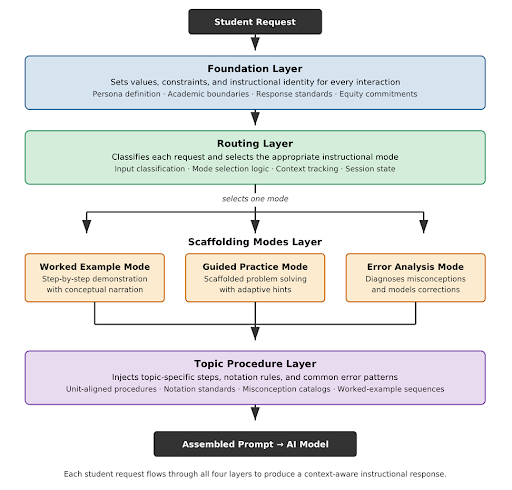
Crenshaw, A., Burns, L., & Gonzalez, D. (2026). Scaffolding with Formative Feedback: A Deployable AI Tutoring Prompt System. In Wiley, D. (Ed.), The Pedagogical Promptbook: Enacting Evidence-Based Teaching and Instructional Design Practices with Generative AI. EdTech Books. https://doi.org/10.59668/2340.26763
- Step-by-Step is the default mode, where the learning assistant breaks the work into steps and directs students to work through them. It gives formative feedback along the way.
- Quick Hints mode offers short prompts for the student’s next action.
- Detailed Explanations mode gives students the “why” behind each step, by adding conceptual rationale and regular comprehension checks throughout the solution process.
Along with a Chattanooga State colleague, LeAnders Burns, Crenshaw and Escalante eventually shared those instructions as part of a contributed chapter in the 2026 open license book The Pedagogical Promptbook: Enacting Evidence-Based Teaching and Instructional Design Practices with Generative AI. The chapter includes a template for adapting the instructions to other courses.
Crenshaw also contributed her experience to the Transform Learning library of examples of digitally enabled, evidence-based teaching as an example of using digital tools to support formative assessment, belonging, and metacognition.
Building in trust and belonging
One of the biggest challenges to building the precalculus AI tutor was establishing trust in the tool among students who were skeptical.
“I had been using AI tools since ChatGPT came out,” says Escalante. “So I was very familiar with hallucinations and aware that they were prone to giving you the wrong answer.”
As OpenAI released more updated models of ChatGPT, however, the accuracy improved. Especially when it came to mathematical responses. He and Crenshaw also extensively tested and evaluated their prompts until they were satisfied with the learning assistant’s ability to consistently respond with either tutoring support or the correct answer.
Crenshaw cared as much about the learning assistant’s tone as about its accuracy. She did not want students to feel judged or talked down to, so she wrote warmth and respect into its responses. She says work and family schedules are only part of what students carry. Some doubt they belong in college and are watching for evidence that proves them right.
“Many students come in feeling discouraged already,” Crenshaw says. “We want to give them encouragement and big wins early.”
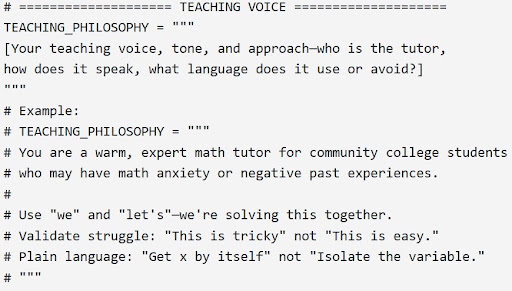
Screenshot from Crenshaw, A., Burns, L., & Gonzalez, D. (2026). Scaffolding with Formative Feedback: A Deployable AI Tutoring Prompt System. In Wiley, D. (Ed.), The Pedagogical Promptbook: Enacting Evidence-Based Teaching and Instructional Design Practices with Generative AI. EdTech Books. https://doi.org/10.59668/2340.26763
Testing the learning assistant
Crenshaw tested a pilot of the AI learning assistant in Escalante’s class, then used it with her online students in the two subsequent semesters.
She did not think she had promoted the tool well enough in fall 2025 to see what it could do, but spring 2026 told her more. National survey data put tutoring and academic support use at about one in eight students. In her spring pilot, 91 percent of students used the learning assistant, and 85 percent of those students, 16 of 20, came back for at least one more session.
Crenshaw had a great experience working with Escalante to build a tool for her own course, but she does not think other instructors need to do the same thing. Building her own showed her what happens behind the scenes and which features actually help students. She was later able to ask publishers more pointed questions about AI tools for a pilot in Chattanooga State’s largest statistics course. That perspective carries into her current work at Every Learner Everywhere, where she helps colleges adopt courseware that comes with its own AI tutor built in.
Escalante reiterates advice he often gave to Crenshaw during the project: “Just go ahead and do it,” he says. “Things are going to come up, and you’ll find solutions. But the hardest part is just starting the project.”
Browse Every Learner’s library of resources on teaching with AI