 Ver todas las publicaciones


Faculty have always had to decide what kind of student work evidences learning. They develop research papers, exams, lab reports, problem sets, discussion posts, and presentations that ask students to demonstrate reasoning, application, synthesis, or judgment. AI has been making those assessment design choices more challenging because students can now produce work in ways that may hide how much they understood, how they used course concepts, or where they struggled.
In Tyton Partners’ Time for Class 2026, an annual report on digital teaching and learning trends in higher education, assessment design is the theme at the nexus of how AI is influencing teaching and learning. Subtitled “That AI Tipping Point,” the 2026 edition is the first year in which more than half of students, faculty, and administrators all say they are using AI at least weekly. The report shows that 47 percent of faculty are modifying assessment design because of AI.
The 2026 edition of Time for Class drew on national surveys fielded in April and May 2026 with responses from more than 300 administrators, 1,500 instructors, and 1,500 students from two- and four-year public and private institutions. In addition to assessment, the report features findings on human connection in digital learning, the top challenges students face, belonging and retention, career-connected learning, and institutional AI strategy and investment priorities.
Another major topic in Time for Class 2026, says Hadley Dorn, Senior Principal and Chief of Staff at Tyton Partners and one of the co-authors of the report, is the impact AI is having on student engagement. She describes how the technology makes it easier for students to complete work without engaging deeply, which is related to, but not exactly identical to, concerns about academic integrity.
“We are seeing faculty articulate that their perception of student cheating is higher than it’s ever been in the history of this survey,” Dorn says. “And we’re seeing concerns that students are not leaning into the critical thinking elements of learning.”
The day-to-day impact of this AI tipping point is showing up in changing assessment practices where some faculty, but not all, says Dorn, “go beyond their historical methods and think more deeply about how to engage students in a way that motivates them.”
How faculty are responding to AI in assessment
The report separates instructors into three groups based on how they are responding to emerging challenges with assessment. The “Status Quo” group is not significantly changing assessment. “Defenders” are responding to AI by returning to more controlled formats such as in-class exams and blue books. A third group, labeled as “Integrators,” is redesigning assessments around AI use through project-based work, iterative assignments, AI disclosure, and student critique of AI output.
Defenders and Integrators are both responding to concerns about academic integrity, but they respond by changing different parts of the learning environment. Defenders create more controlling conditions. Integrators redesign the work itself so students demonstrate reasoning, application, collaboration, or revision.
Integrators assign an average of 22 percent of the course grade to AI-incorporated assessments and report fewer challenges with attendance and cheating than Defenders because “Integrators are taking a redesign approach to their courses,” Dorn says. “They’re implementing AI policies that are more permissive, they are integrating project-based work in a meaningful way, and they are using AI more creatively, not just for their day-to-day responsibilities.”
AI-integrated assessment centers on making the process of thinking more visible. An instructor might ask students to submit drafts showing how their argument or solution changed over time. Another might ask students to critique an AI-generated answer, identify omissions or errors, and explain what a stronger response would require. Another might use an oral follow-up, presentation, or project defense to ask students how they approached a problem and why they made particular choices.
Perception gaps
In surveying students, faculty, and administrators, Time for Class illuminates gaps in how each group perceives an issue. For example, as the 2026 edition shows, academic integrity may be the problem faculty see first, while students identify workload anxiety, mental health, and financial stress as their top challenges.
“Students and faculty are talking past each other right now,” Dorn says. “When you have a majority of faculty saying student cheating is the number one concern and you have a majority of students saying, ‘Well, I’m struggling with my workload and with life challenges,’ faculty are going to be solving for a problem that’s not addressing the root of what students are articulating. There’s a broader ecosystem risk inherent with inaction at this moment.”
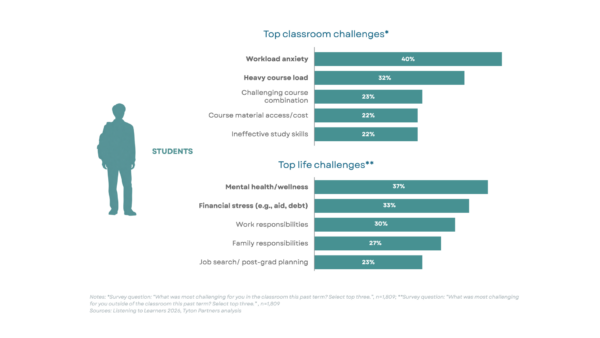
Credit: Time for Class 2026, Tyton Partners
Another sharp divergence is in whether relevant project-based learning is happening in courses: 61 percent of faculty say they assign real-world projects, while 26 percent of students report completing one.
“I think it’s a signal issue on some level,” Dorn says. “I don’t know that faculty are articulating something as simple as, ‘This type of project is something you’ll encounter once you get a job out of college.’”
Likewise, Time for Class 2026 reveals a 10-percentage-point gap between how confident administrators and students are in how well courses prepare them for the workforce. (The survey shows that career-connected learning is an emerging trend for promoting engagement, findings that echo Every Learner Everywhere’s recent report on career readiness in gateway courses.)
Turning AI policy into assessment practice
Discussing AI policies, the report recommends setting institutional expectations while providing instructors course-level models that help them preserve meaningful work, reduce ambiguity for students, and keep human interaction visible in the learning process. Over 60 percent of the institutions surveyed do not yet have a live AI policy, “so there is a level of stagnation,” Dorn says. “They don’t want to publish anything that’s going to be outdated next year. But these need to be living, breathing documents that need to change over time.”
Another finding Dorn highlights is that the majority of students using AI say a policy banning it would not stop them in most cases. “These tools are here to stay,” she says. “Going back to blue books to get control over students is not going to solve the broader disengagement challenge. The survey results are a call to action for faculty to really interrogate their assessment approaches and to think about incorporating AI as part of the learning process, but also part of bringing students together.”
Download Time for Class 2026