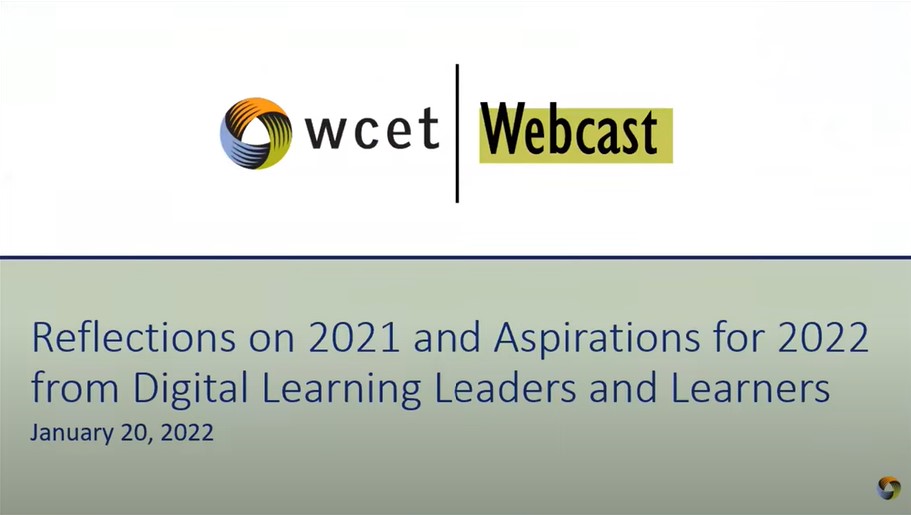
We are all still aboard the pandemic roller coaster and the journey has had its ups, downs, thrills, and near spills, but we in higher education have learned a lot and have much to look forward to in the New Year. In this webcast, our passionate and inspiring conversationalists shared hopes and aspirations for what’s to come in 2022. Moderator: Carrie O’Donnell, Founder & CEO, O’Donnell Learn. Speakers: Jennifer Seymour, Vice President, General Education & Applied Technologies, WSU Tech; Kelvin Thompson, WCET Steering Committee, Executive Director, Center for Distributed Learning, University of Central Florida; Jessica Rowland Williams, Director, Every Learner Everywhere®; and Kiara Williams, Education Outreach Coordinator, 3D Girls, Inc.
View recording without audio description View recording with audio description View TranscriptRecommended citation:
O’Donnell, C., Seymour, J., Thompson, K., Rowland Williams, J., and Williams, K. (2022, January 20) Reflections on 2021 and Aspirations for 2022 from Digital Learning Leaders and Learners [Webionar] Every Learner Everywhere®
Other Related Resources
abril 2026
This resource examines the growing trend of U.S. colleges and universities integrating career readiness into academic courses, with particular attention to gateway and general education courses early in degree programs. It focuses on how students experience the relevance of what they learn in these early courses, and it provides strategies institutions can use to help students experience that relevance earlier, more explicitly, and more consistently.
marzo 2026
The IIRP Graduate School’s Course Design for Student Success Rubric, is a robust rubric, designed to support student engagement, access, and success across varied learner populations and institutions, including undergraduate, graduate, 2-year, etc. We want to inspire faculty, instructional designers, and administrators along their path of continual improvement.
enero 2026
This report offers a student-centered examination of generative AI in higher education—not a guide or endorsement, but a record of genuine student inquiry into AI’s potential and limitations. Students are already using AI, regardless of institutional policies. This student research helps faculty understand not just what tools students are using, but how they’re thinking about AI’s role in their education.