 See All Posts

Many academic programs have as a stated objective ensuring every student is included in the learning experience, but it’s not always obvious how to measure that goal. This gap was identified by Valerie Bloom, an instructional designer at the International Institute for Restorative Practices (IIRP) as she read through its new strategic plan in 2019.
“A goal said we should ‘embed diversity into the curriculum,’” says Bloom. “I thought, ‘Well, how will we know if we’ve actually done that?’ When we go into reaccreditation [with The Middle States Commission on Higher Education], we’ll have to demonstrate that we met that goal.”
Irrespective of accreditation requirements, diversity is particularly important for IIRP, a graduate school that specializes in degrees in the field of restorative practices in education and other community settings. Restorative practices strengthen relationships between individuals, improve social connections, and bridge gaps across divided groups. A premise of restorative practices is that humans are happier, healthier, and more productive when others do things with them, rather than to them or for them.
Including every learner, therefore, is in the DNA of IIRP’s academic programs, but the institute didn’t have a plan to assess that, so Bloom proposed to her provost the idea of a rubric to measure the diversity objective in the strategic plan. After two years of development, Bloom and her colleagues created the Course Design for Student Success Rubric. The rubric seeks to empower teaching-focused faculty and their departments to collaborate for greater student success by fostering student engagement, inclusivity, access, and success in the classroom.
Now the IIRP is collaborating with Every Learner Everywhere to make the Course Design for Student Success Rubric available to other colleges and universities, along with a companion resource on continuous improvement.
Developing the rubric for student success
Bloom’s first step when she began working on the rubric was to search for other examples that measured inclusivity in course design, but none quite fit the needs of the IIRP, and some were counterproductive. For example, Bloom wanted a way faculty and departments could assess building a foundation of trust and honesty in the classroom.
“One [rubric had] a box you could check if you ask every student their name and pronouns,” she says. “To me, that sounded awful if you haven’t done the groundwork to make it safe for someone to share that.”
After pulling together the most relevant parts of all the rubrics she found in her research, she called in three colleagues “who live and breathe this work” to move her draft forward. That group spent six months working carefully on each cell of the rubric. “We’d run out of time, take a break, and come back to it in the next meeting,” Bloom says.
“We didn’t want to check boxes. We needed to know that when the user marked something as ‘meeting expectations,’ it truly meant something. We wanted a solid, robust rubric people could be proud of.”
How the rubric supports inclusive teaching
Like other rubrics, the columns of the Course Design for Student Success Rubric lay out a scale with levels of achievement. In this case, they are: not started, approaching expectations, meeting expectations, and exceeding expectations.
The rows of the rubric lay out 20 standards related to support, costs, accessibility, opportunities for students to provide feedback, learner-to-learner relationships, representation, bias, and more.
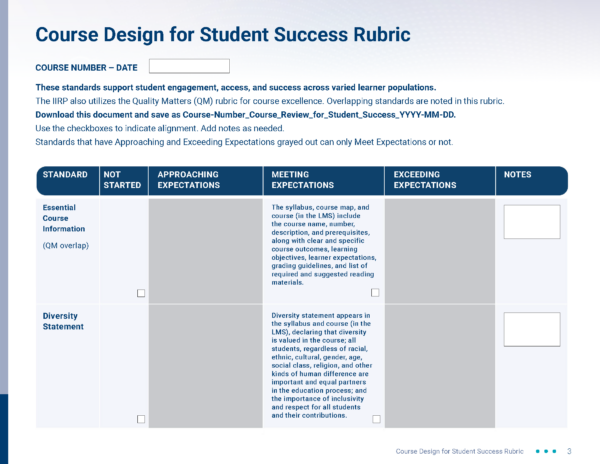
One of those standards is faculty positionality, an understanding of how an instructor’s background affects their work in the classroom. Bloom and her colleagues began discussing this with a question: What practices do we actually mean when we say the faculty member is inviting people’s entire identity into the classroom?
Rather than a one-sided demand that students share information such as their cultural background, Bloom and her colleagues felt that exchange should start with the instructor. The natural place to begin, she says, is with a positionality statement on the syllabus: a brief statement outlining an educator’s social, cultural, and political identities and how these factors influence their work in the classroom.
At the time the rubric was being developed, most educators at the IIRP already included a positionality statement in their syllabi, but the team wanted to codify the elements of a strong and welcoming positionality statement. For example:
- Approaching expectations: The instructor introduces themselves personally; maybe in a welcome video, a welcome letter, or taking time in the first synchronous meeting to get acquainted.
- Meeting expectations: The instructor shares their personal and professional background and talks about how they came to be interested in the topics they teach, and why the field is important to them. They explain why they’re in this work.
- Exceeding expectations: The instructor describes their lived experiences and explains how those experiences influence their professional role and how they teach the course.
For example, says Bloom, “I might say: ‘I’m a divorced white woman in my 50s. I’m from Philadelphia, grew up in a secular Jewish household, and raised two kids as a single mom.’ When faculty are able to model that kind of openness — being proud and a bit vulnerable about who they are and how that shapes their teaching — it normalizes identity‑based reflection for students. That connects directly to welcoming students’ whole identities into the classroom.”
Collaborating with Every Learner Everywhere
Once the rubric was complete, Bloom wanted to share it with faculty and instructional designers at other institutions as a way of giving back to the community. After all, it was informed by other rubrics shared publicly for Bloom to find.
In June 2025, Bloom attended a conference on AI in higher education and met Emilie Cook, Every Learner Everywhere’s senior manager of content, community and digital engagement. Over lunch, Bloom shared more about the Course Design for Student Success Rubric and Cook says, “My ears perked up, because a lot of what we do at Every Learner is quality digital learning and course design. Anytime someone’s doing really great work in that space, as the content person I’m immediately very interested and want not only to feature their work but be involved in a meaningful way.”
Over the next several months, Every Learner worked with Bloom and her colleagues to refine and add to the rubric, including material to address technology and accessibility, such as the recently updated WCAG 2.2 standards.
Every Learner also developed a companion piece with recommendations for continuous improvement. “We thought it was important to add that because we’re all guilty of doing really great work and then not looking back,” Cook says. “Really good teaching and learning practices include continuous improvement, keeping core themes in mind as you move forward and, each time you teach a course, revisiting the rubric as a reminder.”
Bloom is delighted the rubric is being shared widely. “This was something we were really proud of, and we know it’s robust. We believe it can be genuinely helpful to others,” she says.
The rubric and the recommendations for continuous improvement are both free to download from Every Learner’s digital learning resource library, and they will also be shared through the organization’s communication channels, including to its large email newsletter audience.
Download Course Design for Student Success Rubric