
 See All Posts
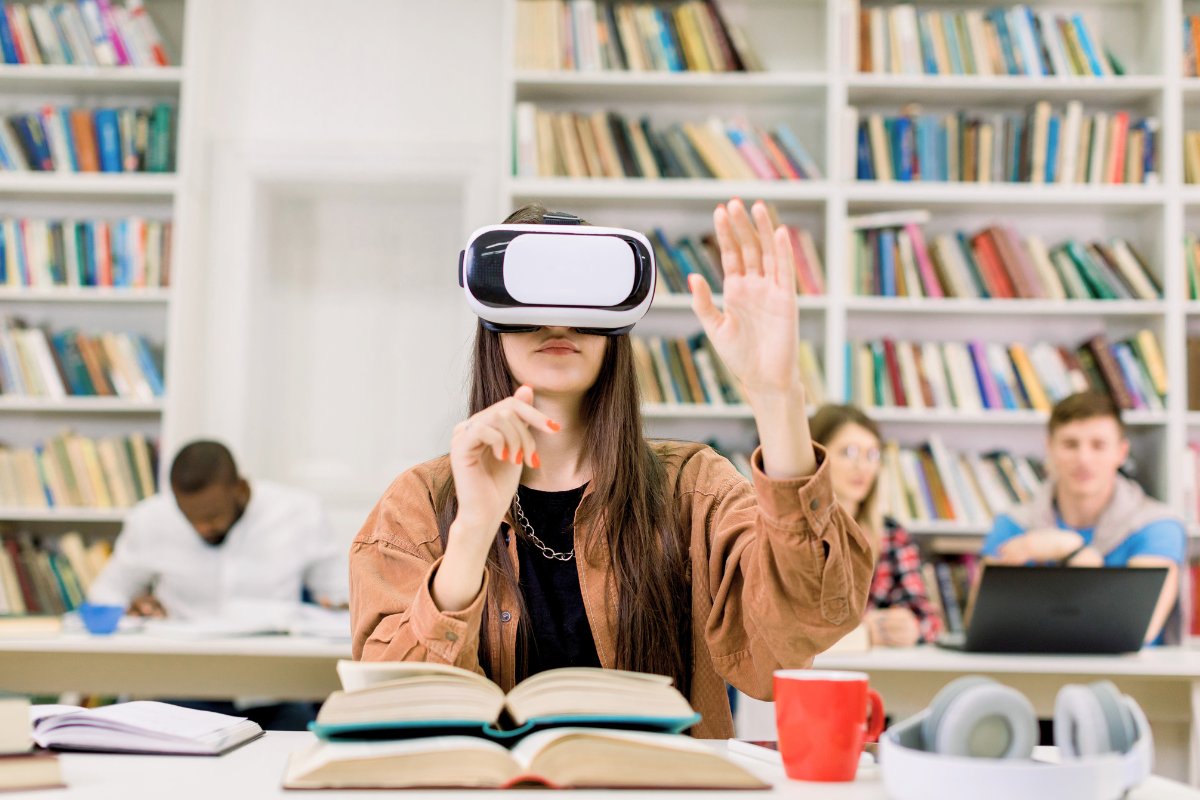
In the 1920s, families gathered around the radio. By the 1950s, they gathered around the television. Each leap added a new sensory dimension to how people received information. Higher education is now living through a comparable shift, but this time the change is not about what students watch or hear. It is about where they stand.
Immersive pedagogy moves learners from looking at a screen to stepping inside the material. For the colleges and universities working hardest to close persistent achievement gaps, that shift raises an urgent question: can teaching inside the lesson reach the students our system has most often left on the periphery?
This is an invitation to join that conversation: what immersive pedagogy is, what the evidence shows, and what we owe students before we adopt it.
What “immersive pedagogy” actually means
Immersive learning is an umbrella term covering Augmented Reality (AR), Virtual Reality (VR), and Mixed Reality (MR). What unites them is not the hardware but the pedagogy. These tools are grounded in constructivist learning theory, the idea that knowledge is not passively received but actively built through firsthand experience and social interaction.
Instead of following a “recipe-like” lab procedure or memorizing an abstract diagram, a student manipulates a molecule, walks a historical site, or runs an experiment in a risk-free virtual setting.
That grounding matters because it reframes the technology as a teaching method rather than a gadget. Immersive environments support experiential learning (hands-on interaction with complex data), situated learning (placing students in authentic, real-world contexts), and co-construction (building understanding together). The value comes from the kind of learning the environment makes possible, not from the novelty of the headset.
The evidence: engagement and outcomes
A growing body of research suggests immersive tools can move the needle on both how students engage and how well they perform.
On engagement, the effects appear across cognitive, behavioral, and affective dimensions. Immersion helps students grasp complex, abstract concepts by letting them visualize ideas in three dimensions; it invites hands-on exploration rather than passive listening; and it generates genuine emotional connection.
In one study, learners in VR reported feeling nearly four times more emotionally connected to the material than peers in a traditional classroom, and that emotional resonance is part of what makes a lesson stick.
On outcomes, the numbers are striking. In a longitudinal study at Arizona State University, students who completed VR biology labs improved their final course mark by roughly a quarter of a letter grade and were 1.7 times more likely to score in the 90–100 percent range. Other comparisons have reported a 14 percent increase in mean test scores and, in one astrophysics study, a 90 percent pass rate for the VR group versus 40 percent for the non-VR group. Researchers using EEG measurements recorded a 15.5-point increase in brain activity during immersive learning, compared with a 3.0-point increase in traditional settings, and students report sharper focus because a head-mounted display blocks many external distractions.
Related reading – Meaningful Pedagogical Transformation: Alternatives to the STEM Faculty Lecture-First Model
Why this is an outcomes question
For institutions focused on outcomes, the most compelling finding in the ASU research is not any single test score. It is that VR students performed well regardless of their high-school preparation, income, or race, and were more likely to persist in their STEM majors. Used well, immersive learning gave students the “ability to feel successful early,” a foothold that disproportionately benefits learners who arrive without a rigorous science background.
There is a subtler success mechanism, too. In social virtual worlds, students are represented by a digital avatar that grants a sense of agency and presence. As researchers at Stanford have noted, choosing an avatar can help a student “see yourself as a scientist,” even if they have felt in the past that they did not fit the mold. That echoes a core principle of evidence-based teaching: helping students imagine themselves as authentic practitioners rather than as outsiders looking in.
Narrative does similar work. When ASU students fight to save fictional creatures from extinction, or when Morehouse College students stand on a virtual slave ship to experience history firsthand, the story supplies an emotional hook that carries learners through the hard, quantitative parts of a course, the moments where motivation most often breaks down.
The cautions we cannot skip
Enthusiasm for any new technology should be tempered by a healthy skepticism of techno-solutionism, the temptation to treat a tool as an automatic fix for learning gaps without first asking who actually benefits. Immersive pedagogy comes with real barriers and naming them is part of adopting it responsibly.
Cost is the most obvious. Headsets, maintenance, and recurring software updates are prohibitive for institutions with limited budgets, even as case studies show immersive labs can sometimes undercut physical ones (a University of Sydney VR lab visit costs roughly AU$19.50 per student). There are health concerns, including motion sickness, eye strain, and headaches. There is a documented gender dynamic: some female students report discomfort or embarrassment wearing head-mounted displays, a “male gaze” effect that, in cognitive-load terms, becomes extraneous load that diverts mental resources away from learning.
Because these systems collect detailed data, including biometric information, institutions must build ethical and privacy frameworks, with attention to regulatory compliance, before scaling. Faculty also need genuine pedagogical training; simply replicating a lecture inside a virtual room squanders the medium’s potential.
Where this is heading
The field is moving quickly from passive viewing toward intelligent interaction. The integration of generative AI now allows immersive environments to respond to a learner’s specific mistakes, adjusting the simulation in real time and offering personalized, scaffolded feedback. Combined with “digital twins,” living virtual representations of physical systems, and emerging metaverse campuses, the trajectory points toward adaptive, scalable learning experiences that are difficult or impossible to stage in a physical room.
For higher education, the invitation is to approach that future the way we should approach any promising tool: grounded in learning theory, guided by evidence, honest about barriers, and centered on the students who stand to gain the most. Immersive pedagogy will not close achievement gaps on its own. But used with intention as a method, not a novelty, it offers a rare chance to let every learner step inside the lesson and to feel, early and authentically, that they belong there.
Learn more about our professional learning opportunities for evidence-based teaching and learningAcknowledgment of use of generative AI – The author used Generative AI to create preliminary outlines and drafts for this article. The final published version is the result of a collaborative editorial process by the author and reviewers. This human-led process ensures the content aligns with Every Learner Everywhere’s educational standards, reflects current pedagogical best practices, and meets the specific needs of learners.