 See All Posts

What is the relationship between effective teaching generally and the specific practices faculty and programs use to incorporate career readiness into academic courses?
If one undeveloped theme of a recent report from Every Learner Everywhere is anything to go by, there appears to be significant overlap. The Career Readiness Imperative in Gateway Courses: A Student Success Perspective, Trend Report, and Emerging Playbook explores how colleges and universities integrate career-relevant experiences into early general education courses. The report shows how a growing number of programs are innovating ways to connect the dots between academic course material and students’ career goals in ways that sustain academic integrity.
While the connection between incorporating career readiness and using evidence-based teaching practices (EBTs) was beyond the scope of the report, echoes of those practices can be heard in many of the interviews and literature that informed it. For example, consider instructional transparency, one of eight EBTs Every Learner centers in its work. Several sources emphasized that instructional transparency is promoted not just by frequent, clear, and consistent references to the course objectives but also to any related career competencies that employers value.
Every Learner is particularly interested in how digital technology can support or even extend the impact of those evidence-based teaching practices. This pairing of digitally enabled and evidence-based teaching practices (DE-EBTs) is outlined comprehensively on Transform Learning, a resource that includes definitions, research, and an instructional examples library.
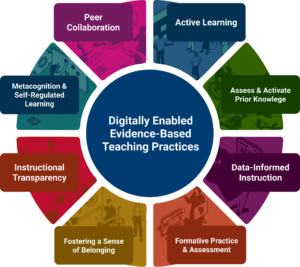 Below is an exploration of how the eight DE-EBTs map onto the competencies employers expect and how they can reinforce career preparedness in academic courses, including high-stakes gateway courses.
Active learning
Active learning asks students to use course concepts in context. That improves mastery, and it also fosters the problem solving, communication, adaptability, and teamwork skills employers emphasize. Digital tools such as polling and collaborative documents can make this kind of activity more inclusive and easier to implement at scale.
In “The Career Readiness Imperative in Gateway Courses,” many faculty describe forms of active learning that give students practice articulating the connection between their academic work and their emerging professional identities. One example of that is using interview simulation software to have students practice explaining how the foundational academic material they learned in a course will be relevant in a hypothetical professional context.
Assess and activate prior knowledge
Assessing and activating prior knowledge helps students recognize what skills they already have and where they need growth, mirroring the career-planning processes students undertake later (skill inventories, gap analyses, reflective career decision making). Diagnostic instruments, early-semester surveys, and brief LMS-based pre-assessments are some of the digital tools faculty use to gain actionable insights and help students build self-awareness about their prior knowledge.
Formative assessment and practice
Formative assessment helps students build mastery through iterative skill development, which is central to career readiness. Low-stakes ways to articulate career competencies are perhaps even more important in early academic courses, where the connection to a specific profession is less clear than in courses in professional majors and students are still exploring their interests.
Low-stakes practice also reflects how professionals refine work through drafts, prototypes, and feedback cycles. Quizzing platforms, automated feedback, and e-portfolio progress checks allow for more frequent checkpoints and help students internalize the rhythm of improvement that employers see as essential.
Fostering a sense of belonging
Highlighting career readiness can foster a sense of belonging for students who bring with them concerns about post-college professional success. Making vivid how a gateway course both prepares students for success in college and supports their career goals helps those students see that their needs and interests are important.
“The Career Readiness Imperative in Gateway Courses” refers to the parallel development of emerging academic identities and professional identities, which can be mutually reinforcing. Students who feel they belong in their major or field are more likely to persist, take on challenging work, pursue internships, and communicate confidently in professional settings. Digital tools that support community (discussion forums, collaborative whiteboards) can help students see themselves as part of an academic and professional community from the start.
Instructional transparency
One of the primary findings of the report is that a fundamental method for addressing career readiness is to “make the implicit explicit.” Most instructors of core academic subjects understand implicitly — and suggest to their students — that they are learning skills that will be valued in the professional world. A simple move to make that implicit assumption explicit is to make assignment sheets “bilingual” by listing both the relevant course objectives and relevant professional skills. (Most programs do this by referring to the career readiness competencies framework from The National Association of Colleges and Employers.)
Metacognition and self-regulated learning
Metacognition and self-regulated learning help students develop the planning and time-management habits employers value. Reflection assignments carried out in e-portfolios or in the LMS and self-assessment checklists build students’ ability to monitor their progress, the same skill set they will later use in internships, onboarding, and early-career roles. The illustrative example from the report in this vein is from a humanities instructor who assigns a traditional research paper. When it is turned in, he asks students to write one reflective letter to him about their work on the assignment and another to an imagined future employer about what they learned. Those low-stakes metacognition activities help students connect the dots between their academic work and their professional preparation.
Peer collaboration
Peer collaboration has perhaps the most direct parallel to workplace expectations. Structured collaboration — especially when supported by digital platforms for co-authoring, giving feedback, or coordinating tasks — helps students practice teamwork, communication, and shared responsibility. These activities mirror real workplace collaboration more closely than traditional solo assignments do.
Data-informed instruction
Timely data helps faculty understand students’ interests and abilities better, identify gaps in understanding, respond or adapt promptly, and personalize instruction. The connection between this evidence-based practice and career readiness lies in the data faculty can use to understand student motivation.
The report begins with an extended argument that faculty should take into account the overwhelming evidence of how much students value courses that make explicit connections between academic material and their professional future. For example, more than 83 percent of students say getting a better job is their top reason for attending college, and minoritized and first-generation students and students from low-income households are more likely to say employment and financial gain are very important factors in their college choice.
Faculty hoping to make academic knowledge relevant and to support the success of every learner should consider how data like this influences how they teach core academic subjects in gateway courses.
Download The Career Readiness Imperative in Gateway Courses