Every Learner Everywhere
Achieving the Dream
Intentional Futures

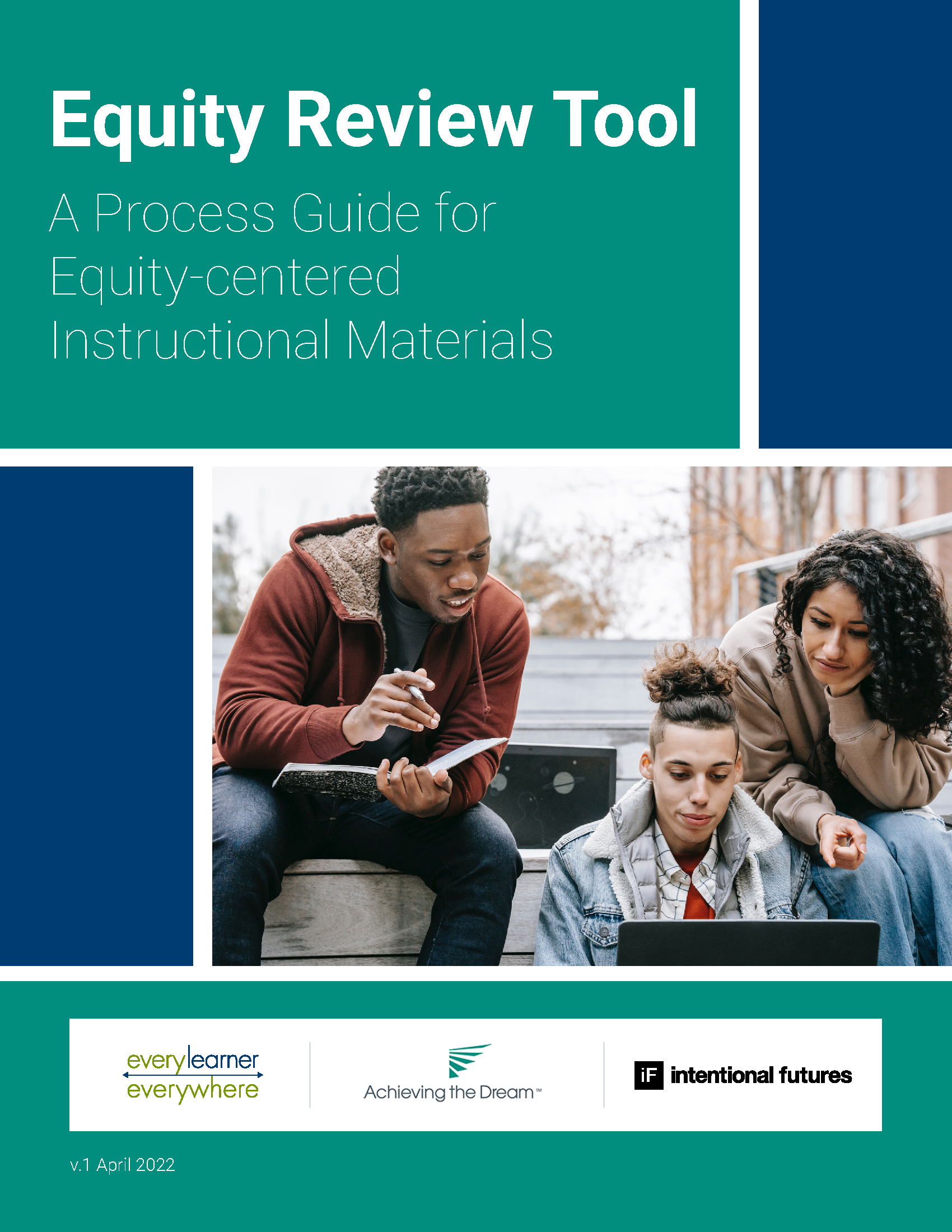
Equity Review Tool

A Process Guide for Equity-centered Instructional Materials

In the constantly and rapidly evolving landscape of higher education, it is important to seek opportunities for continuous evaluation and improvement. The equity review tool is designed for educators striving to create more validating and affirming learning experiences and environments for students who are Black, Latino, Indigenous, poverty-affected, first-generation, non-male-identifying, LGBTQIA+, and/or disabled. To do this well, it is critical to understand the intersectionality of these identities and how that may affect a student’s experience.

One important aspect of creating a more validating learning environment is ensuring that the instructional materials being used in college courses are conceptualized and constructed leveraging equity-minded competencies and processes. Using this tool, educators will be able to develop and evaluate their resources and the language they use to ensure they are asset-based and supportive of a more equitable teaching and learning process.

The equity review tool goes beyond the basics to help educators explore the “why” of a) developing instructional resources that amplify minoritized and marginalized voices and support optimal learning for students of a broad range of diverse backgrounds and b) using asset-based language that privileges, empowers and accurately represents students who have historically been excluded and marginalized in higher education due to their race, cultural background, etc. This tool poses critical questions that help surface and confront privilege, bias, exclusion, and/or misrepresentation and promote the use of equity-minded language. Rather than a simple checklist, the tools, resources, and processes provided are meant to be a continuous journey to enable reflection and discussion as often as possible during the process of creating or revising instructional materials.

Download the Equity Evaluation Tool
Recommended Citation

Holiday, T. & Gable, T. (2022 April 22). Equity Review Tool: A Process Guide for Equity-centered Instructional Materials. Every Learner Everywhere®. https://www.everylearnereverywhere.org/resources/

Other Related Resources

Pillar Resource
Three college students walk on a campus path in front of a brick building, one in casual attire with a tablet, another in a suit with a backpack, and the third in military uniform carrying a folder. Image depicts the career readiness imperative.

April 2026

This resource examines the growing trend of U.S. colleges and universities integrating career readiness into academic courses, with particular attention to gateway and general education courses early in degree programs. It focuses on how students experience the relevance of what they learn in these early courses, and it provides strategies institutions can use to help students experience that relevance earlier, more explicitly, and more consistently.

Resource Cover page from The IIRP Graduate School's Course Design for Student Success Rubric with title, photo of student holding tablet and org logos.

March 2026

The IIRP Graduate School’s Course Design for Student Success Rubric, is a robust rubric, designed to support student engagement, access, and success across varied learner populations and institutions, including undergraduate, graduate, 2-year, etc. We want to inspire faculty, instructional designers, and administrators along their path of continual improvement.

Pillar Resource
COVER page of Student Research Into How Students and Faculty Use AI- Insights for Teaching and Learning with title and photo and every learner everywhere logo.

January 2026

This report offers a student-centered examination of generative AI in higher education—not a guide or endorsement, but a record of genuine student inquiry into AI’s potential and limitations. Students are already using AI, regardless of institutional policies. This student research helps faculty understand not just what tools students are using, but how they’re thinking about AI’s role in their education.