Every Learner Everywhere
Achieving the Dream

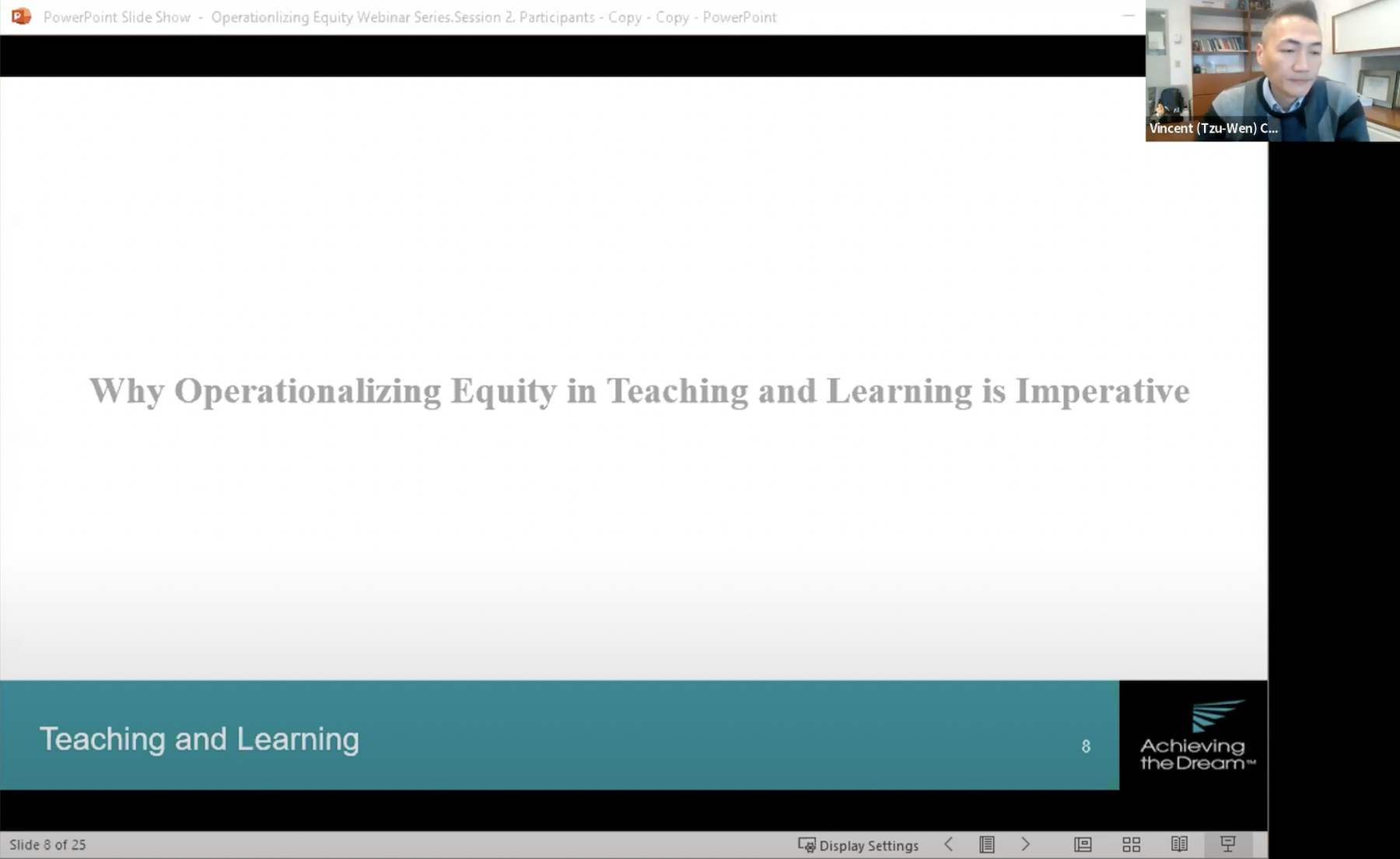
Operationalizing Equitable Teaching and Learning Practices

The process of engaging in and implementing equity, diversity, and inclusion can be daunting. The process should be incremental while demonstrating impact in equitable student outcomes. In this webinar, panelists will share components/tenets to purposefully embed equity, social justice, and inclusion into innovative teaching and learning in face-to-face and virtual spaces. Through a moderated discussion, participants will examine protocols, approaches, and digital enhancing techniques that put into action practices that lead to equitable outcomes in teaching and learning.

This is the second webinar in the four-part Operationalizing Equity, Social Justice, and Inclusion to Transform Teaching and Learning Webinar Series, hosted in partnership with the Every Learner Everywhere® Network. The series will provide a multi-pronged approach for advancing inclusive teaching and digital learning, where participants will engage in moderated panel discussions led by diversity, equity, and inclusion (DEI) experts. Sessions will focus on embedding inclusion, equity, and social justice in course content; the process of operationalizing equity in the classroom; developing culturally responsive assessments; and creating inclusive teaching and learning environments.

Presenters: James Gray of Community College of Aurora; Vincent (Tzu-Wen) Cheng of the Borough of Manhattan Community College; and Stephanie Whalen of Harper College

View recording without audio description View recording with audio description View Transcript
Recommended citation:

Gray, J., Cheng, V., and Whalen, S. (2022, March 18) Operationalizing Equitable Teaching and Learning Practices [Webinar] Achieving the Dream and Every Learner Everywhere®

Other Related Resources

Pillar Resource
Three college students walk on a campus path in front of a brick building, one in casual attire with a tablet, another in a suit with a backpack, and the third in military uniform carrying a folder. Image depicts the career readiness imperative.

April 2026

This resource examines the growing trend of U.S. colleges and universities integrating career readiness into academic courses, with particular attention to gateway and general education courses early in degree programs. It focuses on how students experience the relevance of what they learn in these early courses, and it provides strategies institutions can use to help students experience that relevance earlier, more explicitly, and more consistently.

Resource Cover page from The IIRP Graduate School's Course Design for Student Success Rubric with title, photo of student holding tablet and org logos.

March 2026

The IIRP Graduate School’s Course Design for Student Success Rubric, is a robust rubric, designed to support student engagement, access, and success across varied learner populations and institutions, including undergraduate, graduate, 2-year, etc. We want to inspire faculty, instructional designers, and administrators along their path of continual improvement.

Pillar Resource
COVER page of Student Research Into How Students and Faculty Use AI- Insights for Teaching and Learning with title and photo and every learner everywhere logo.

January 2026

This report offers a student-centered examination of generative AI in higher education—not a guide or endorsement, but a record of genuine student inquiry into AI’s potential and limitations. Students are already using AI, regardless of institutional policies. This student research helps faculty understand not just what tools students are using, but how they’re thinking about AI’s role in their education.