 See All Resources




Turn your introductory math courses into a launchpad for student success — not a barrier to it.
Introductory college mathematics is the single largest academic barrier to college completion and STEM success, especially for students from historically underserved groups. These courses carry the highest DFW rates on campus, derailing student momentum and weakening the nation’s STEM pipeline. The frustrating truth? We already know what works. Decades of research have produced proven, scalable reforms. The real challenge is putting them into practice.
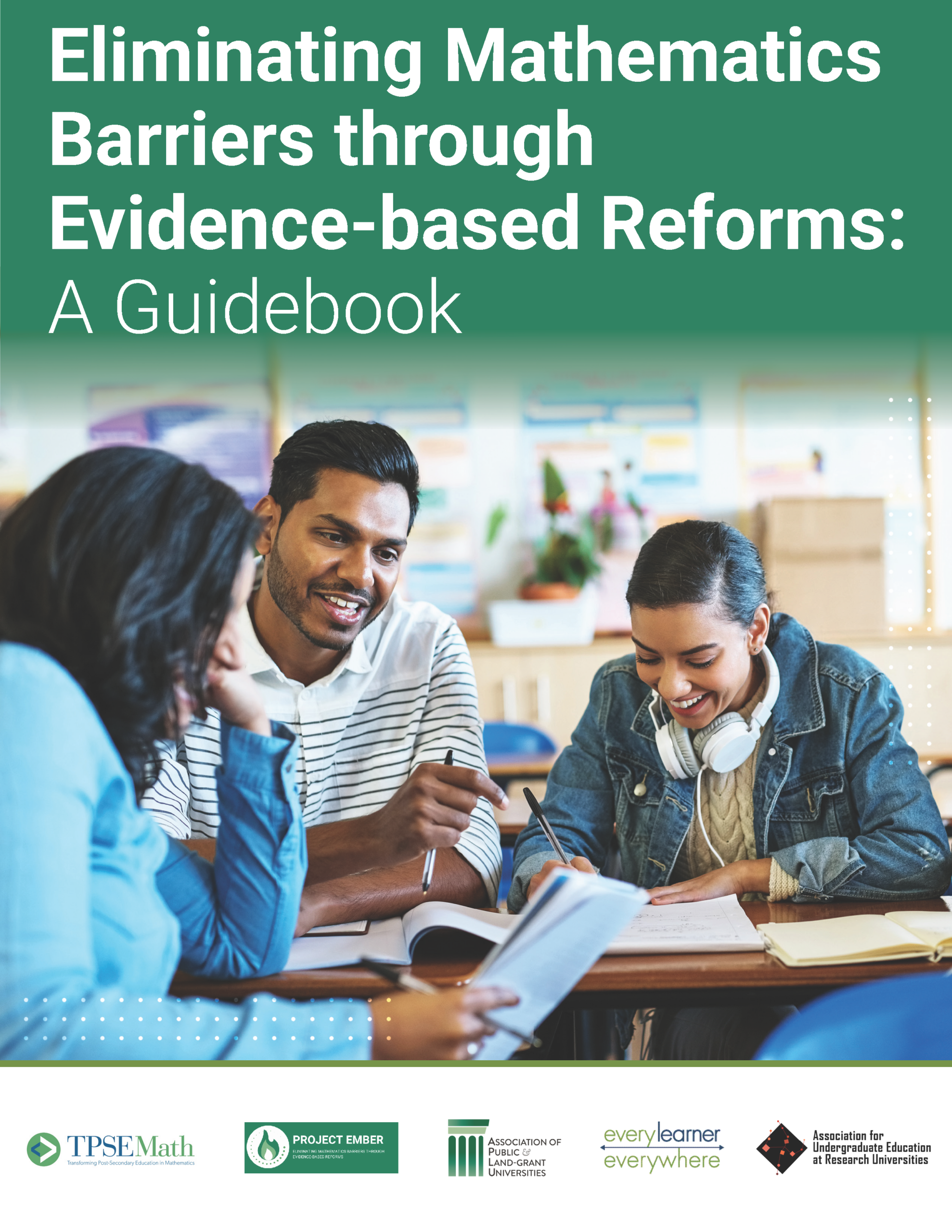
This guidebook, developed by Every Learner Everywhere in partnership with Project EMBER (Eliminating Mathematics Barriers through Evidence-based Reforms), a collaborative initiative of TPSE Math, APLU, and The Association for Undergraduate Education at Research Universities (UERU), gives your institution a clear, practical roadmap for transforming introductory mathematics, from first conversations to lasting, systemic change. This isn’t a theoretical framework. It’s a field-tested, action-oriented resource grounded in real research and real institutional experience, designed to help your team move from “we know something needs to change” to “here’s our plan, and here’s who’s doing what.”
- A Proven, Step-by-Step Framework: Follow a three-milestone process — Empowering the Team, Assessing Current Practices, and Planning for Transformation — that has helped research institutions nationwide move from stalled intentions to real, measurable reform.
- Guidance for Building the Right Team: Learn how to assemble a cross-functional team that spans university, department, and course-level stakeholders — including the often-overlooked but essential voice of students. Real scenarios show exactly what’s gained (and lost) when key perspectives are missing.
- A Self-Assessment Tool with Seven Rubrics: Get a structured way to evaluate where your program stands today across student success data, climate for change, course structure, student support, coordination, professional development, and instruction/assessment.
- Five Evidence-Based Innovation Hubs: Discover Project EMBER’s curated areas for action — Active Pedagogy, Math Pathways, Student Supports, Course Coordination, and Tech-Enabled Curriculum & Assessment — to focus your energy where it matters most.
- A Real Institutional Case Study: Walk through an institution’s full change journey, complete with a detailed goals-and-action-plan matrix, showing how one urban research university redesigned its College Algebra–to–Calculus I sequence.
- Built-In Professional Learning Guidance: Practical strategies to help teaching-focused faculty grow into confident, capable change agents — because sustainable transformation requires more than good intentions.
Start building a shared vision for the future of introductory mathematics at your institution!
Download the Guidebook