 See All Resources


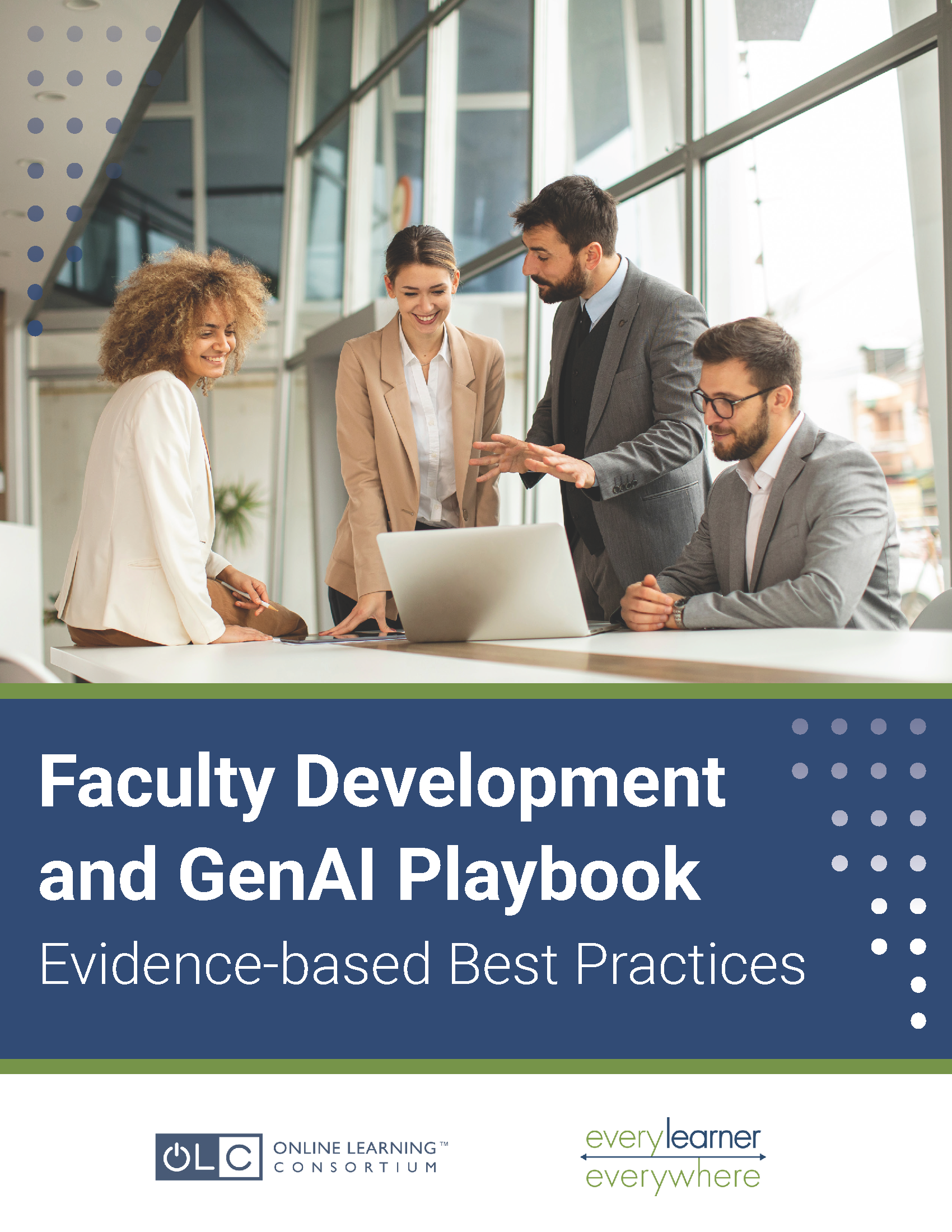
Evidence-based Best Practices
Faculty development is a critical lever for enhancing teaching and learning in today’s higher education landscape. This playbook provides strategies to Faculty Development practitioners in Centers of Teaching and Learning (CTL) to develop effective and valuable programming around GenAI. Grounded in research, the playbook is designed to guide faculty development professionals in colleges, universities, and other higher education organizations to develop and implement GenAI professional development opportunities for faculty and staff.
To explore and evaluate the strategies, challenges, and resources employed by CTLs in higher education institutions across the United States in response to the rapid emergence of GenAI technologies in academic settings, OLC researchers conducted a mixed-methods study. By conducting a comprehensive survey followed by in-depth interviews with CTL leaders and directors, this research sought to provide a nuanced understanding of the current landscape of GenAI integration in higher education and to identify best practices and future directions for supporting faculty in this evolving educational environment.
Key findings include:
- Widespread Acknowledgement of GenAI’s Permanence: Across the dataset, both survey and interview respondents expressed strong consensus that GenAI is here to stay.
- Diverse and Evolving Faculty Development Models: Most CTLs offer multi-pronged approaches: webinars, book clubs, microcredentials, modular courses, and department-specific consultations.
- Pragmatic Faculty Engagement with Nuanced Resistance: Barriers to engagement include time constraints, lack of institutional incentives, and emotional/ethical tensions surrounding AI.
- Policy Approaches: Decentralized but Guided: Institutions generally avoid rigid, centralized policies in favor of guidance frameworks, such as the “traffic light” (Red/Yellow/Green) model.
- Positive and Negative Pedagogical Impacts: Positive uses include brainstorming, assignment revision, generating feedback, and simulating case scenarios.
- Resource Limitations and Structural Challenges: Most programs operate with limited staffing, budgets, and incentives. Common CTL sentiments include being under-resourced and over-extended.
- Future Directions: Embedded AI Literacy and Scalable Infrastructure: Programs emphasize the need for agility — short-term planning cycles, rapid iteration, and ongoing environmental scanning.